Introduction
Foreword

Something changed in how enterprise buyers research and decide. They are no longer finding answers through search rankings in the way they once did. AI systems are summarising, filtering, and citing, and the signals those systems reward are different from the ones most enterprise marketing teams have optimised for. Structured content. Technical cleanliness. Verified authority. For organisations whose web infrastructure was built in a different era, this is not a future risk. It is a present one.
That shift lands differently in DACH than it does anywhere else in Europe. The region’s enterprises built their digital estates deliberately, on platforms chosen for compliance, governance, and organisational structure. TYPO3, AEM, Rezolve FirstSpirit, SitecoreAI: each chosen for legitimate reasons, each capable of doing what it was designed to do. The problem is not that these platforms are wrong. The problem is that the ground beneath them has moved, and the speed at which marketing teams can now act, publish, test, and adapt has become a competitive variable in its own right.
At Webflow, we think about this through four lenses: Content, Technical, Authority, Measurement. What we call AEO readiness. Not as a replacement for what enterprises have already built, but as a layer that lets marketing teams operate with the agility the current environment demands, without dismantling the governance structures that DACH organisations rightly require.
The teams getting the most from this model are not simply moving faster. They are widening their lead: every experiment shipped, every content variant adapted for a new market, every page that gets cited rather than skipped is another iteration ahead of a competitor still waiting on a release window.
This book is grounded in real DACH enterprise experience, from teams navigating compliance requirements, procurement chains, multi-stakeholder approval, and the legitimate complexity of operating at enterprise scale in a region that does not simplify easily. It is honest about where this works, where it is harder, and what it actually takes.
Foreword

I have been building companies for almost 15 years now, and I noticed a pattern across all of them, no matter the size. The marketing teams were never short on ideas. They had campaigns they wanted to run, landing pages they wanted to test, stories they wanted to tell. What they were short on was a way to get any of it live. Every idea turned into a ticket, every ticket into a queue, and somewhere in that queue, most of the good ideas quietly died.
For a long time, I assumed that was simply how the web worked. We built our sites on WordPress and whatever else was around; we waited on developers, and we accepted that a new landing page was a project rather than an afternoon. Then in 2019, I came across Webflow, and for the first time, the distance between an idea and a published page started to close. Designers could build. Marketers could ship. The website stopped being a bottleneck and started being something the team could actually move.
That experience is the reason magier exists. When I sat down three years ago to decide what to build next, I kept returning to the same problem I had lived through again and again. Marketing teams without enough design and development capacity. Agencies that were slow and expensive. Freelancers who were brilliant but could not carry an entire website on their own. So we built the thing I would have wanted to buy as a founder, a team that gives marketing the design and Webflow capacity it needs without the wait. Since then, we have launched more than a hundred Webflow projects across the DACH region, and we have learned where this works, where it gets hard, and what it takes to do it properly.
Underneath all of it sits one pattern. The problem was never really the CMS. The problem is that most platforms sit between the team that owns the outcome and the team that operates the tool, so every change becomes a handover. In DACH, that gap is wider than almost anywhere else, because on top of it sits a real and legitimate layer of compliance, data protection, and governance that no one can simply wish away.
This book is my attempt to map that landscape honestly. I spoke with marketing and digital leaders across the region, on Webflow and on everything else, and I have tried to give you their real experience rather than a sales pitch. That includes the parts where Webflow is clearly the right answer, and the parts where it is not yet. AI has changed how buyers find answers, the web is shifting under all of us, and the teams that win will be the ones who can build, publish, and adapt at the speed their market actually moves.
If your website still feels like a queue you are waiting in rather than an engine you are running, this book is for you. I hope it helps you close that gap, the same way closing it changed every company I have built.
Why this book exists
The best marketing teams in DACH are never short on ideas. What holds them back is rarely the team; it is the platform underneath. This book is about giving the speed back to the people who own the results.
The platform underneath most DACH enterprise websites was chosen eight to twelve years ago by an IT function working to a legitimate checklist: audit trail, integration depth, single sign-on, sovereign hosting, vendor longevity. None of those criteria included a line that read: a campaign manager must be able to publish a localised landing page in one afternoon.
That gap is what this book is about.
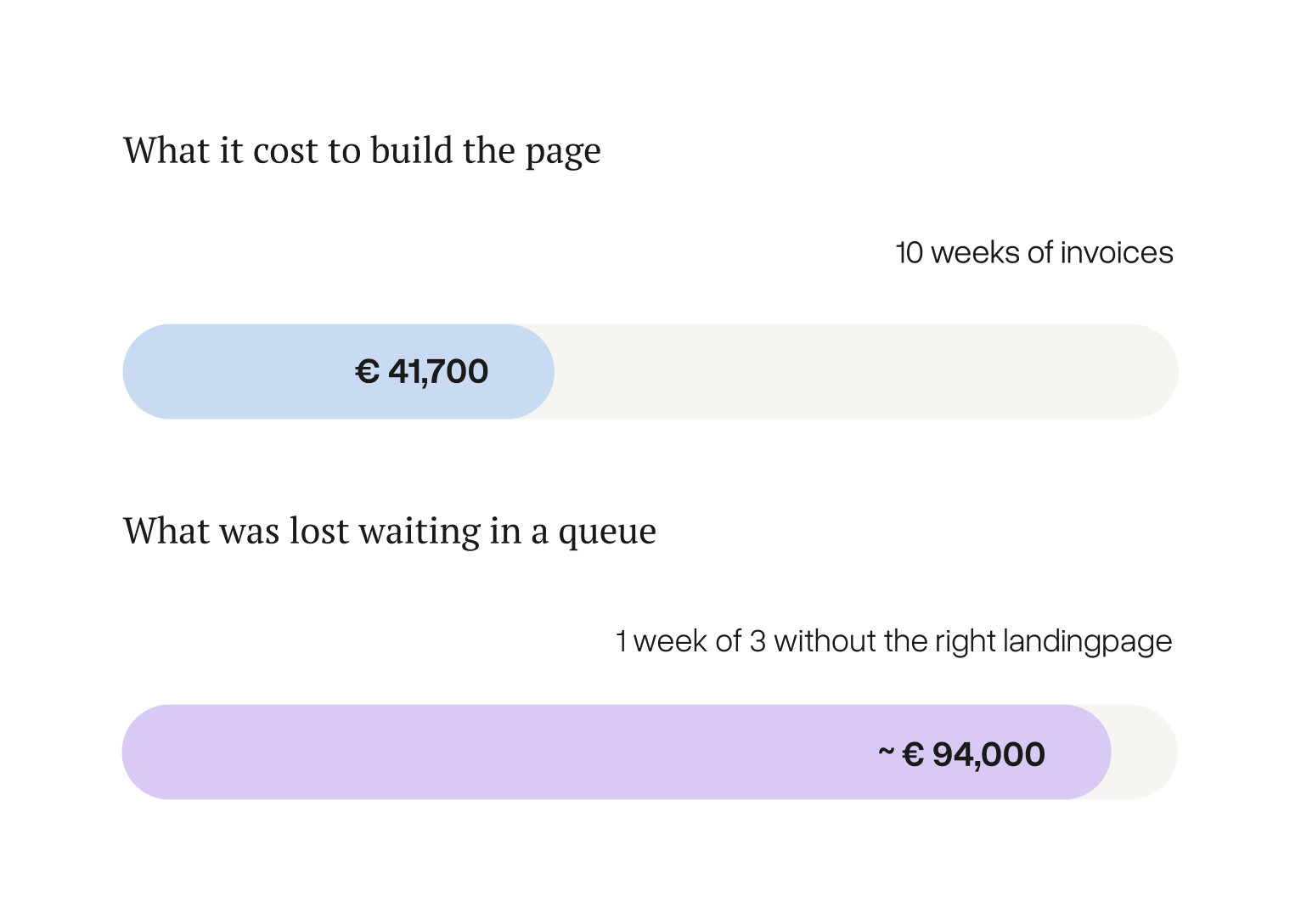
The cascade in Chapter 1 puts a number on it. A single landing page for a product launch. Eleven weeks from brief to live. €41K in direct costs. Booked media airtime wasted because the page was not ready. Every line item sits in a different cost centre, invisible as a single figure. The Chief Financial Officer has never seen this as one number. This book gives the marketing team the arithmetic to build it.
The thesis of this book is that Webflow is the right surface for the marketing layer of a DACH enterprise. Not for every surface. Not as a replacement for TYPO3 on federal-sovereign infrastructure, or for AEM at DAX-40 personalisation scale, or for Contentful in a MACH-native content-as-API architecture. For the corporate site, the product-marketing surface, the careers hub, the PR newsroom, and the campaign pages that decide whether media spend converts, Webflow is the right surface. Federated against the systems of record that earned their place, it gives the marketing team its own operating system.
This is a field guide, not a sales document. The platform verdict in Chapter 8 rates Webflow strong on five of nine axes — on three of them as the only platform — and adequate on the other four. Webflow does not hold a BSI C5 attestation. It does not offer EU-only data residency for standard customers today. It does not match the AEM at the DAX-40 complex enterprise experience architecture. A guide that does not say those things in plain terms is not a guide. It is a brochure.
The book has three sections. Section I diagnoses the problem: the friction cost, the six platforms that carry it, the talent bottleneck, and the AEO gap that makes most DACH enterprise sites invisible to the engines their buyers now use. Section II explains what Webflow offers: the code output, the cost model, the AEO stack, and the comparison against every platform that competes for the same surface. Section III is the playbook: the diagnostic, the stakeholder chain, the 90-day rollout plan, and the partner rubric. The appendices are the artefacts: the compliance matrix, the platform analysis, the TCO model, the procurement templates, and the glossary.
The book is dated June 2026. The regulatory citations are accurate as of that date.
Section IThe Broken Web
This section diagnoses what running a legacy website platform actually costs a DACH enterprise today, before the book turns to what to do about it. The argument starts with the cost of friction in a number that a finance director can recognise. It moves through the six platforms that friction lives inside. It then explains who can build on Webflow today and who cannot, and why most DACH enterprise sites are invisible to the engines their buyers now use to find them.
Four chapters. Chapter 1 names the cost. Chapter 2 maps the platforms. Chapter 3 explains who gets to build. Chapter 4 explains why the site is invisible to AI.
| Chapter 1 | The €140K Landing Page |
| Chapter 2 | The Great CMS Divide in DACH |
| Chapter 3 | The Talent Bottleneck |
| Chapter 4 | Why Your Website Is Invisible to AI |
Chapter 1.The €140K Landing Page
Most DACH enterprise marketing teams have one. Almost none have put a number on it.
The scene
Monday, 09:00. The Chief Marketing Officer of a German luxury-goods group with €800m in revenue opens the weekly stand-up. The product launch is in Q3. The campaign brief is signed. The media plan is booked: three weeks of European airtime across four markets, total spend €280,000.
At 10:15, the brief lands on the marketing operations team. The first question they ask is the one this book is about.
“How fast can we ship the landing page?”
The honest answer, on a legacy website platform, is somewhere between three and eleven weeks. It depends on the approval load. It depends on whether the design system already has the components the campaign needs. It depends on whether the approval review queue is empty. It depends on whether the integration with the lead-capture tool still works after the last platform update.
Eleven weeks is the realistic worst case, the far end of the three-to-eleven-week range. The airtime window is three weeks, tied to a fixed event. The brief is signed on time, and the media plan leaves enough runway on paper. What blows the schedule out is everything that happens once the work hits the legacy platform: one mid-project brief change, one underestimated development ticket, and each of them dragging through the same slow concrete of missing components, compliance gates, and release windows.
The website is the revenue engine.
One honest recalibration before the cost cascade. The enterprise website today is not a cost centre. In DACH, it is still treated that way in many organisations, often for understandable reasons: compliance load, risk posture, and IT-led procurement that predate the current growth brief. But the reality on the ground has shifted. For most marketing teams, the site has become the single largest revenue-driving asset they operate, even if the cost codes and governance chart still tell a different story. It carries the top-of-funnel awareness, the mid-funnel product stories, the partner-facing case studies, the careers funnel, the press-driven traffic spikes, and the campaign pages that decide whether media spend converts.
The question is what the friction between the marketing team and its website costs in revenue that the company is not earning.
That friction is one of the highest uncounted costs in DACH enterprise marketing, and, unlike most of the constraints in this book, it is genuinely fixable.
The cascade
What follows is a composite, not the average launch. It is the launch most marketing leaders recognise from their worst quarter, drawn from a German luxury-goods Mittelstand with one site, four markets, and a creative agency on retainer. The source is anonymous. The figures are representative, modelled from a high-friction composite, not from a single audited project.
| Week | Event | Cost |
|---|---|---|
| 1 | Brief signed. Wireframes commissioned from agency A. | €3,500 retainer pro rata |
| 2 | Wireframes approved. Design commissioned from agency B. | €7,000 design fee |
| 3 | Design approved. Development ticket opened. The ticket sits behind two earlier ones in the developer queue. | €0 direct. One of the three airtime runways is gone ≈ €94,000 |
| 4 | Development begins. A three-day dependency on a CMS template update. | €6,500 dev |
| 5 | Development continues. The component library needs a new module. | €8,000 dev |
| 6 | Staging deploy. Brand team review. Two rounds of revisions. | €4,500 dev + €2,500 design |
| 7 | Legal review. One blocking comment on the consent banner. | €2,800 legal counsel |
| 8 | Legal cleared. Accessibility audit. Two blocking issues. | €400 audit + €3,000 dev |
| 9 | Data Protection Officer sign-off. One blocking question on form routing. | €1,500 counsel |
| 10 | Brand governance and accessibility review against the master template. | €2,000 internal time + agency standby |
| 11 | Page goes live. Two weeks of airtime remain. | €0 |
Over eleven weeks, the organisation spends just under €41,700 to get a single landing page live, before you count any media. No one ever sees that as one number, which is why it rarely sounds alarming. It is sliced across an agency retainer, design and development cost centres, external legal counsel, an accessibility audit, and internal governance time.
The more expensive part of the story is not in that total. The page goes live at the start of week 11, with only two of the three booked airtime weeks still in play. Roughly one third of the €280,000 media plan has already run, while the page it is meant to convert on simply does not exist, bringing the cost close to €140K. Those spots still air and the impressions still happen, but the conversion path the campaign is designed around is dark, and nobody books three weeks of European airtime for impressions alone.
Now add the numbers that do sit in plain sight but are never added to the same column. In this composite, the enterprise platform licence sits in the low-to-mid six figures, a typical range for an AEM-class suite in DACH. Integration and support contracts add another six-figure amount to keep the platform tied into the CRM, consent tooling, and analytics stack. By the time you include the slice of the agency retainer that exists mainly to work around the platform’s constraints, the annual cost of this operating model lands well into the high-six- to low-seven-figure range. In boardroom language, this company is paying close to a million euros a year for the ability to publish marketing pages slowly.
Finance has never seen this as a single number. Every line item belongs to a different owner, so the true cost of friction never appears on one slide.
One honest note on the last row, because the cascade above makes it necessary. Webflow does not delete weeks 7 to 10. Legal review, the accessibility audit, and the Data Protection Officer exist regardless of the platform, and any vendor who tells you otherwise is selling past your compliance team. What Webflow removes are weeks 3 to 6: the developer queue, the template dependency, the missing component module, and the revision cycles that each demand a deployment window.
The build drops from weeks to hours, which also changes the shape of the governance time that remains. Reviews run against a live page that can be corrected the same afternoon, in parallel, instead of queuing serially behind a development backlog. The realistic enterprise outcome is days, not hours, and days are enough: the eleven-week cascade still loses to it just as decisively.
Why does the cascade keep happening
Three reasons, none of them the marketing team’s fault.
The platform was not originally chosen for marketing speed
The website platform was selected years ago by an IT function, against criteria that were legitimate at the time: audit trail, integration surface, single sign-on, exit strategy. None of those criteria said, “A campaign manager must be able to publish a localised landing page in one afternoon.”
Marketing is downstream of the tool its outcomes depend on
Every change the marketing team wants now routes through the team that chose the platform. The CMS that the Chief Information Officer defended in 2018 is the same one the Chief Marketing Officer is now trying to bypass. The ticket queue is, in practice, a recurring cost the organisation pays for this separation.
The surrounding process has grown heavier
The DACH compliance stack today carries the BFSG (Barrierefreiheitsstärkungsgesetz, the German Accessibility Reinforcement Act), the DSGVO re-papering cycle, and the NIS2 supply-chain review. None of these existed in the 2018 ticket plan, and the platform was never built to absorb them.
The architectural fault
Legacy website platforms were built for a world in which IT departments controlled the site and marketing processes moved on quarterly cycles. That architecture separates the team that owns the outcome (marketing) from the team that operates the tool (IT). Every change the outcome-owning team wants becomes a work order to the tool-operating team. The queue is, in practice, a recurring cost the organisation pays for that separation.
No amount of platform tuning will fix this because the separation is structural.
The Forrester comparison, in plain terms
The Forrester study1Forrester, Total Economic Impact of Webflow Enterprisewebflow.com/resources/report/forrester-tei on the Total Economic Impact of Webflow Enterprise from 2024, measures what a re-platform actually changes for the company. The numbers below are the headline rate-of-change figures from the same composite customer used above.
These numbers come from a $2bn-revenue organisation with a ten-person content team on $125,000 fully burdened salaries. The Mittelstand profile in this chapter is smaller on headcount and larger on approval overhead. The 94% time-to-market improvement holds.
The same page on Webflow, the three-day version
When the team that owns the outcome also operates the platform, everything moves faster. Most of the speed gain is not from fewer approvals but from less production friction: fewer developer queues, fewer release windows, fewer rebuilds of the same component for the next campaign.
Legal, data protection, brand, and accessibility reviews all still happen. They just move faster because the team running them is not waiting on a developer to recode a template first.
-
Monday
Brief signed at 09:00. The campaign manager opens the Webflow CMS at 10:15. Six existing components in the design-system library. Two fields added to the product schema. Page drafted by 16:00.
-
Tuesday
Brand review at 10:00. Two edits applied live in the canvas. Legal review at 14:00. The consent banner is pre-configured at the platform level. The accessibility check via the Webflow accessibility audit2Webflow accessibilitywebflow.com/accessibility runs on the platform; two colour-contrast fixes applied. The Data Protection Officer signs off at 16:30 on the form routing, which has not changed from the template.
-
Wednesday
Page goes live at 11:00, three locales, with Webflow Analyze tracking and a Webflow Optimize A/B test routing twenty per cent of traffic to a variant.
Two developers were not involved. Production-queue friction on this launch: effectively none.
The reframe
The headline number is a single-company composite. It is not the average launch, and that is the point: most DACH marketing teams have never seen these line items as one number. The regulations did not create the problem; they made an existing one heavier. You still run legal, data protection, and accessibility checks, just without a developer in the middle of each one.
Webflow does not remove compliance work. It removes the steps that exist only because the platform needed a developer in the loop - all from within a single platform. The €36K cascade is not the failure of any one CMS. It is what happens on any platform whose architecture sits between marketing and execution.
The enterprise website has moved from cost centre to the single largest revenue-driving asset that most marketing teams operate. The cost model in this book treats it that way.3Forrester, Total Economic Impact of Webflow Enterprisewebflow.com/resources/report/forrester-tei
Dr. Wolff: a 120-year-old brand house testing at campaign speed on Webflow

Dr. Wolff Group is a family-owned business from Bielefeld with seven brands, names like Alpecin, Plantur, Bioniq, and Linola. It has a history of 120 years, employs around 930 people, and booked revenue of €384 million in 2025. With more than 40 percent of that now coming from outside Germany and the international share still climbing. It is the kind of company that rarely calls itself an enterprise and runs at enterprise scale anyway.
Its brand and commerce sites run on a headless stack: Storyblok for content, Shopify for the shop, built on a shared multi-brand design system so it scales across seven brands and more than fifty country markets. Webflow sits on a different surface. It runs the landing pages behind the paid online marketing campaigns. The place where speed decides whether the media budget actually converts.
“We are a data-driven company. So we look at the results of our campaigns. So in marketing, we need to iterate quickly and ship this to production and to our customers. That is the whole game,” says Julian Rüter, who leads websites and shops across the group. “We want to make changes fast, see the results fast, and move on to the next thing. Fast. That is exactly what Webflow enables us to do.”
The split is deliberate. On the headless stack, a meaningful change to a product page moves through a backlog, a week of UX, a week of development, then review and testing, so something normally lands in about three weeks. That is the right amount of process for sites that carry deep product ranges across seven brands and have to stay maintainable for years. It is the wrong amount of process for a campaign that needs a landing page this week. So the campaign work runs on Webflow, where Rüter’s team builds the page, tests components on it, and when something wins, that component gets built back into the main stack. A social-proof block on a product page, a pricing variant, a new layout: the test happens on Webflow at campaign speed, and only the proven version earns the development cost on the headless side.
This is also why the honest limitation matters. Rüter does not build the deep brand sites on Webflow, and he says so plainly. Page depth, the advice content, the studies, the large structured product libraries, is where he still reaches for the headless stack, and the commerce logic of a subscription model belongs there too. Webflow earns its place by being the fastest surface for the work that has to move fast, not by claiming the work it is not yet the best tool for. That discipline is what makes the setup hold and what will be discussed later in the book.
Two forces are pulling more of the work toward Webflow over time. The first is translation. “Auto-translation is going to be core for us, because it scales in no time, and to a standard solid enough to hand straight to the local market and say: ready, take a look,” Rüter says. International is where the growth is: it reached 41 percent of revenue in 2025, up from 35 percent the year before, and the brands keep entering new countries, most recently Alpecin and Bioniq into Brazil. At that pace, fast and translatable landing pages are the difference between launching a market in days and weeks. The second is hosting. Dr. Wolff currently exports the Webflow build and hosts it itself, a setup Rüter calls once needed and is nowadays probably more complex than it should be. So he is weighing a move of hosting to Webflow as EU data residency, and the platform’s newer controls make that the simpler path.
What the case shows is not that Webflow replaces the enterprise stack. It shows where a visual development platform earns its keep inside one: the layer where marketing tests, learns, and ships at the speed its media budget demands, then feeds the proven work back into the system of record.
Sidebar
- Family-owned, founded 1905, headquartered in Bielefeld, Germany.
- Seven brands, among them Alpecin, Plantur, Bioniq, and Linola.
- 2025 revenue €384.4 million, 41 percent of it international.
- Selling in more than 50 countries.
In Numbers
Chapter 2.The Great CMS Divide in DACH
Six incumbents + Webflow run the DACH enterprise web. Each was chosen for honest reasons. Each puts the marketing team one step away from publishing.
What is Webflow?
Webflow is a visual development platform that lets teams design, build, and run production-grade websites through a browser-based canvas instead of hand-coding every layout and interaction. It combines a designer, CMS, hosting, and governance controls in one system, so the same tool you use to model content and structure is also the one that ships the HTML, CSS, and JavaScript that run in production.
At a platform level, Webflow sits in the gap between traditional CMSs and template-driven “website builders.” It exposes core web concepts like the box model, classes, and responsive breakpoints in a visual way, so designers and marketers can work directly with the underlying structure while Webflow generates clean, standards-based code behind the scenes. Unlike a monolithic CMS that assumes a theme layer, or a locked-down site builder, Webflow functions more like a visual IDE for the web: you define layouts, content types, and interactions, and the platform compiles that into a real site you can host on Webflow’s infrastructure or export as code.
The company behind Webflow was founded in 2012–2013 by brothers Vlad and Sergie Magdalin and their co-founder Bryant Chou and came through Y Combinator’s S13 batch with an explicit focus on professional-grade, no-code web creation. After a modest seed round in 2014, Webflow largely bootstrapped to profitability before accelerating growth with larger rounds, culminating in a 2022 Series C that valued the company at around 4 billion dollars and brought total funding above 330 million dollars (as of March 2022). Today, Webflow is led by CEO Linda Tong, who took on the role in mid-2024 after serving as COO and then president, with co-founder Vlad Magdalin shifting to a chief innovation role.
Crucially for this book’s audience, Webflow isn’t just a tool for side projects or portfolios — it powers sites for more than 300 000 companies worldwide, including many brands your stakeholders already know. On the global side, Webflow underpins properties for Dropbox Sign (formerly HelloSign), DocuSign, Anthropic, Rakuten, Verifone, Typeform, and other enterprise-oriented companies that treat their website as a growth and demand-generation channel. Well-known digital brands like Upwork, Monday.com, The New York Times, Spotify, and TED use Webflow for parts of their marketing and content footprint, which makes it easier to position the platform as a credible, “safe” choice rather than a niche experiment.
In the German-speaking (DACH) market, you see the same pattern. Regulated players like Liqid, a digital wealth manager, run on Webflow — a useful proof point when compliance and governance objections surface later in the book. Growth-stage and mid-market brands such as Enpal (solar and energy), Haufe (publishing and business media), sevDesk (SaaS accounting), Softr (a no-code platform that runs its own site on Webflow), and specific divisions inside industrial groups like Thyssenkrupp use Webflow for their public-facing sites, often citing speed of iteration and design control as key reasons. Even in more traditional sectors, Webflow adoption shows up at the brand or product-line level — for example, consumer brands under the Dr. Wolff Group using Webflow for selected marketing experiences.
Global Brands Using Webflow









German Companies using Webflow








Taken together, these customer examples make Webflow easier to champion inside a sceptical organisation. Stakeholders don’t just hear that Webflow is a “modern website platform”; they can see that companies like Dropbox Sign, DocuSign, Anthropic, Typeform, and recognised DACH brands already rely on it to run regulated, revenue-critical sites and that those teams chose Webflow precisely because it gives them speed, design control, and integrated hosting without sacrificing governance.
A note on language
Two terms, used with a deliberate distinction. CMS is the layer that stores content, structures it, and exposes it for editing. Website platform is the operating system on top of that layer: design, publishing workflow, governance, hosting, performance, optimisation, and the tooling between the team and the live page. A CMS is one layer of a website platform. The book follows that distinction. The glossary entry sits in Appendix I.
Six platforms, one map
The DACH enterprise estate in 2026 runs on six legacy names + Webflow. WordPress at the volume tail. AEM and Sitecore at the DAX-40 and regulated mid-market. FirstSpirit in industrial, automotive, and banking. Contentful, where composable-first MACH thinking won the architecture argument. TYPO3 as the German-language workhorse, with 71.3% of customers in Germany, 8.2% in Switzerland, 6.4% in Austria, and 86% of all global instances inside DACH (TechnologyChecker, April 20264technologychecker.io/technology/typo3technologychecker.io/technology/typo3).
As of April 2026. DACH enterprise CMS share of estate, drawn from the 2025 Gartner Magic Quadrant for Digital Experience Platforms5Gartner Magic Quadrant for Digital Experience Platforms 2025, via CX Todaywww.cxtoday.com/contact-centre/gartner-magic-quadrant-for-digital-experience-platforms-2025-the-rundown, W3Techs April 20266W3Techs, content management overvieww3techs.com/technologies/overview/content_management, and BuiltWith DE trends7BuiltWith, Adobe Experience Manager website list, Germanytrends.builtwith.com/websitelist/Adobe-Experience-Manager/Germany.
| Platform | Where it dominates | Team-ownership model | Gartner MQ 2025 | Licence + Yearly Cost |
|---|---|---|---|---|
| TYPO3 | German public sector, sovereign, Mittelstand | IT-operated | Not rated | €0 licence + €30k to €150k per year support |
| Adobe Experience Manager | DAX-40 and regulated industries | IT-operated, Martech-configured | Leader | €250k to €1m+ per year |
| SitecoreAI | Mid-market DACH, insurance, premium automotive | IT-operated | Visionary | €100k to €500k per year |
| Rezolve FirstSpirit | DACH automotive, banking, industrial federations | IT-operated | Not rated | €100k to €400k per year |
| WordPress (VIP at the top) | Broad DACH SME to enterprise, media, and publishing | Mixed, leans marketing | Not rated | €25k to €100k+ per year |
| Contentful | Composable-first, MACH-aligned organisations | IT-operated | Niche Player (new entrant) | €43k to €300k+ per year |
| Webflow Enterprise | DACH growth and Mittelstand marketing surface | Marketing-operated | Not rated (Webflow is a website platform, not a Gartner DXP) | €60k to €200k+ per year |
The full per-platform teardown, including install bases, architecture notes, developer-dependency profiles, and the verdict on when each platform is the better choice than Webflow, lives in Appendix B (The Comparison: Platform Analysis). That appendix is built to be torn out and brought to a buying committee.
This chapter stays on the argument.
The honest case for each
Each of the six has a reason for existing. None of them is a marketing tool by birth.
- TYPO3 is the only platform on the list with no licence cost and no inherent CLOUD Act exposure when self-hosted on German infrastructure, and an active digital-sovereignty posture written into its constitution. Powers Government Site Builder for German federal and Länder administrations. The DACH choice when ‘No US cloud’ is policy, not preference.
- Adobe Experience Manager is the deepest enterprise platform in the set. 2,772 deployments in Germany (BuiltWith8BuiltWith, Adobe Experience Manager by country, Germanytrends.builtwith.com/cms/Adobe-Experience-Manager/Country/Germany). SAP, BMW Group, DHL. 100-plus market localisations through Translation Integration Framework. Million-asset Digital Asset Management (DAM). Server-side personalisation at DAX-40 complexity. The right answer where that complexity is the work.
- SitecoreAI holds DACH insurance, finance, and premium automotive. TISAX certified (Sitecore Trust Centre9Sitecore Trust Centretrust.sitecore.com). Behavioural personalisation tuned for regulated customer flows. The right answer where TISAX is a procurement gate and the personalisation logic is the product.
- Rezolve FirstSpirit is German-DNA, Dortmund-headquartered since 1999, acquired by Crownpeak in 2021 and by Rezolve AI in December 2025 (PR Newswire10Rezolve AI acquires Crownpeak, PR Newswirerezolve.com/press-releases/rezolve-ai-defines-the-future-of-commerce-with-acquisition-of-crownpeak). Reference deployments at GROHE, Lekkerland, Commerzbank, SEG Automotive. The most comprehensive native BFSG auditing in the set, through DQM ConnectRezolve. The right answer where multi-site, multi-language complexity is the work — managing content across dozens of sites and markets in 50-plus languages.
- WordPress powers 41.9% of all websites globally and 59.4%11As of mid-2026. of the CMS market (W3Techs April 202612W3Techs, content management overvieww3techs.com/technologies/overview/content_management). The plugin marketplace is its strength and its largest NIS2 supply-chain risk. WordPress VIP is the managed-enterprise tier with SOC 2 Type I (WordPress VIP blog13WordPress VIP, SOC 2 Type I attestationwpvip.com/blog/soc2-type1-attestation) and a FedRAMP Moderate ATO. The right answer for large media and publishing brands with the in-house WordPress capability to govern the plugin stack.
- Contentful was founded in Berlin in 2013. Niche Player new entrant in the 2025 Gartner MQ (CX Today14Gartner Magic Quadrant 2025, via CX Todaywww.cxtoday.com/contact-centre/gartner-magic-quadrant-for-digital-experience-platforms-2025-the-rundown). The best API surface in the set. AWS Frankfurt EU data residency on Enterprise (Contentful Security15Contentful securitywww.contentful.com/security). HARTING Technology Group runs 19 markets and 100-plus editors on it (Contentful case study16Contentful case study, HARTINGwww.contentful.com/case-studies/harting). The right answer for DACH-native stacks where content-as-API is the architectural centre. As of June 1st 2026, Contentful is being acquired by Salesforce.17Salesforce agreement to acquire Contentfulwww.salesforce.com/news/stories/salesforce-signs-definitive-agreement-to-acquire-contentful
What ties them together
Six platforms. Six honest cases for existence. One structural fault they share.
- TYPO3: the business unit requests, the agency integrator builds.18The business unit can maintain content itself.
- AEM: the business unit authors components, the systems integrator builds the stack.
- SitecoreAI: the business unit requests, the frontend team chooses the framework.
- FirstSpirit: the business unit edits text, the developer team builds the template.
- WordPress: the business unit edits blocks, the developer governs the plugin stack.
- Contentful: the business unit updates fields, the frontend team builds the render.
That is the cascade in Chapter 1, viewed from the platform side. It is what the million euros pays for. Every year. On every platform on this list.
Compliance at a glance
Before the federation argument lands, the question a Chief Marketing Officer hears next is the trust question. Does the platform under the marketing surface clear the DACH regulatory bar?
For Webflow Enterprise, in April 2026, the answer is yes for the marketing surface of a DACH enterprise. One current gap is named, and one roadmap item is signposted. The summary the boardroom needs is below.
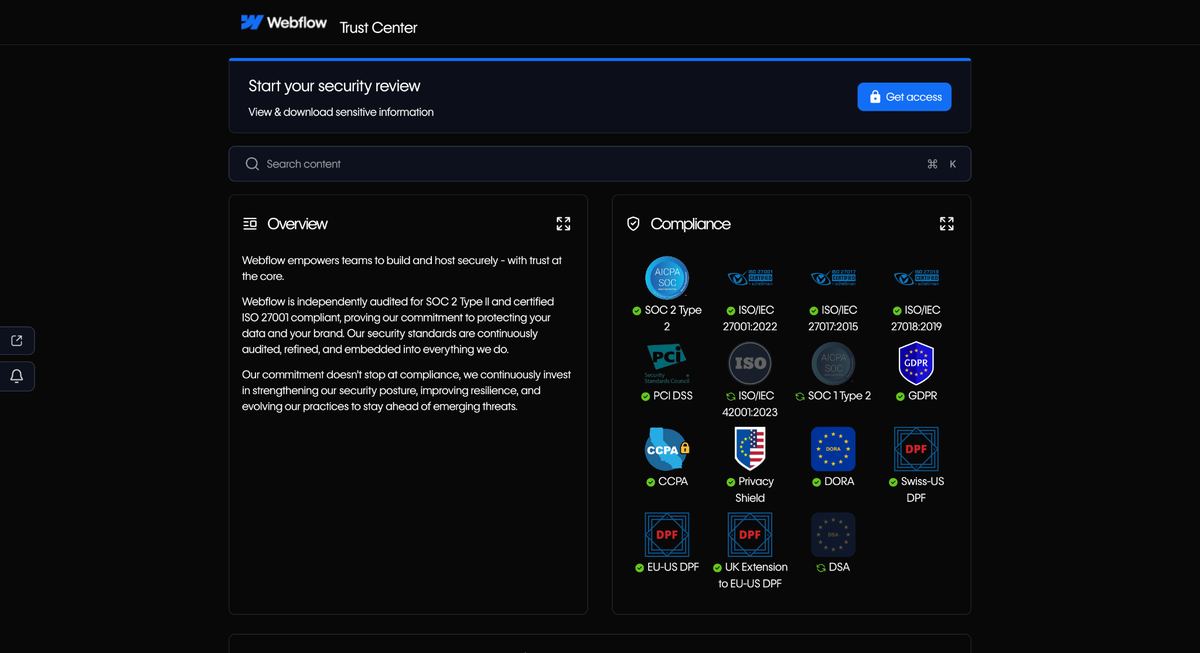
Webflow checks these boxes today (Webflow Trust Center19Webflow Trust Centertrust.webflow.com):
- DSGVO, revDSG, österreichisches DSG. Pre-executed Data Processing Addendum via DocuSign, with EU Standard Contractual Clauses Modules 1, 2, and 3. EU-US, Swiss-US, and UK Extension Data Privacy Framework certifications. ISO/IEC 27001:2022 attested by Schellman & Co20Schellman & Cowww.schellman.com.
- ISO/IEC 27017, 27018, and 42001:2023 (Webflow’s AI management system certification).
- SOC 2 Type II and SOC 1 Type II, independently audited.
- DORA and DSA listed at the Trust Center. Sub-24-hour incident notification contractually committed. Sub-processor list public and updated.
- BFSG and EAA: semantic HTML5 tags assignable in the Designer rather than emitted blindly, ARIA attribute support, site-level accessibility audit tools, and generic WCAG/EAA-aligned accessibility resources (including example accessibility statements) through Webflow’s documentation and learning materials21Webflow accessibilitywebflow.com/accessibility.
- TTDSG and TDDDG § 25: Native integration with OneTrust, Consentmanager, and Usercentrics, integrated via script. A separate Webflow-native consent platform is not needed.
- Schriftform: DocuSign at the qualified or advanced level, accepted by the German legal market.
In plain terms. Webflow does not hold a BSI C5 attestation. Where C5 matters (German federal procurement, BSI-KRITIS critical infrastructure, DigiG-scoped healthcare, the BSI-graded subset of BaFin-regulated entities), the marketing surface stays on the C5-attested estate until Webflow attests. Where it does not matter (the substantial majority of the DACH enterprise market), the compensating controls path through ISO 27001:2022 plus SOC 2 Type II plus the contractual DORA Art. 28 register entries carries the audit.
The one roadmap item. EU-only data residency for standard customers is on the Webflow roadmap22Webflow wishlist, EU data residencywishlist.webflow.com/ideas/WEBFLOW-I-3429 for 2026, with no public date. Procurement teams routinely sign multi-year contracts where the residency clause activates on Webflow’s general availability of the option.
The detail behind every line above (the scope of each regulation, the maximum fines, the enforcement body, the contract clauses Procurement needs to negotiate, the documents the compliance programme produces) sits in Appendix A, with each row cited to its regulator and each Webflow claim cited to the Trust Center or to vendor documentation. Chapter 10 carries the diagnostic that turns this into a procurement decision.
The federation answer
The working answer is not ‘Replace every CMS in the estate’. The working answer is federation. Each surface of the website estate goes to the platform whose shape it actually needs.
The marketing surface (corporate site, careers, PR, product marketing, event microsites, campaign pages) goes to a tool the marketing team can operate. The DAX-40-complexity surface stays where it is and connects to the marketing surface through an integration.
For roughly 80% of a DACH enterprise’s web estate by traffic, and 100% by marketing return, Webflow is the right surface. That scope does not need a million-asset DAM. It does not need 100-market localisation, server-side behavioural personalisation, or BSI C5.
For the remaining 20% by traffic, the platform whose shape matches the surface stays in place. TYPO3 for federal sovereignty. AEM for enterprise-scale governance and multi-market complexity. Sitecore for automotive TISAX. FirstSpirit for an 80-country federation. WordPress for media cadence. Contentful for MACH composability. The connections between them and the Webflow marketing surface are named in Appendix B.
What this means for you
The case for Webflow is not that it wins on every axis against every platform. For the 80% of a DACH enterprise web estate that does not need a DAX-40-scale CMS, the cost cascade in Chapter 1 is the wrong price to keep paying.
The more useful question is which surfaces of your estate would move faster without a platform sitting between Marketing and execution, and which surfaces federate well with a marketing layer that moves at campaign cadence.
The next two chapters look at what changes when Webflow widens the group that can ship, and at why most DACH enterprise sites are currently invisible to the engines their buyers use to find them.
“We’ve doubled our organic traffic, which is very much attributed to Webflow because of the constant improvements that they’re making to their platform”.
Chapter 3.The Talent Bottleneck
Webflow widens the group of people who can ship and frees developers to focus on the work that genuinely requires their expertise and time.
Who gets to ship
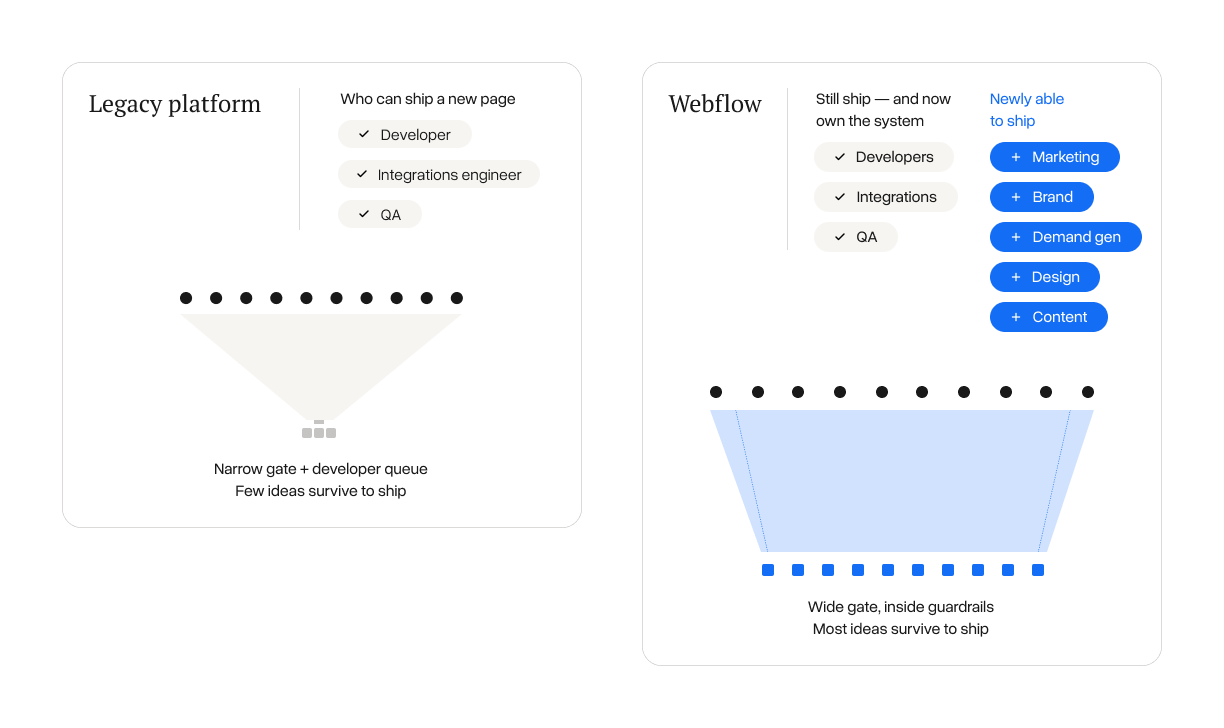
On a legacy website platform, plenty of people can touch the site, but few can ship a page. An editor can change copy or swap an image on an existing page, and most modern platforms handle that fine. The moment the campaign needs a new page, the circle shrinks to a handful of specialists: senior front-end developers with the platform certification, an internal QA reviewer, and an integrations engineer for anything that touches the product information system.
On Webflow, the group of people who can publish is the team that owns the outcome: Marketing, Design, Content, Brand, Demand Generation. The same people who briefed the campaign can now ship the page.
Most of this book is about what that change does to the work. This chapter is about what it does to the team.
What changes when the group widens
Three things change in the same quarter.
Ideas survive longer
The Chapter 1 cascade ends with a campaign manager publishing a campaign landing page eleven weeks into a twelve-week window — with one of the three booked advertising weeks already expired. Half the cause is the developer queue. On the platform the marketing team operates, the campaign that lost its landing-page slot in October can still ship in October. The drop-off between an idea on a whiteboard and a page in production shrinks. Briefs that used to get scoped, costed, and quietly removed from the next sprint plan now make it past the first review.
Iteration cadence rises
Forrester’s Total Economic Impact study of Webflow Enterprise24Forrester, Total Economic Impact of Webflow Enterprisewebflow.com/resources/report/forrester-tei recorded one customer’s sprint cycle moving from six weeks to one after migrating to Webflow. That is the headline number. The structural number sits underneath it. A team that ships once a quarter runs four campaigns a year, while a team that ships once a week runs about fifty. The variance between best-case and worst-case launches collapses because the worst case is a small page change rather than a delayed quarterly release.
The website becomes a growth surface
Most DACH legacy sites run the website as a queue managed by IT. Marketing logs tickets, then IT sequences them. The website is treated as a capacity-constrained shared resource. When Marketing operates the platform directly, the same surface starts behaving like a growth channel with content experiments run weekly and pages retired when they stop performing. The team measures iteration count rather than project completion.
The cost figures in Chapter 1 describe the bill for running it the old way. The shift in who can build is what makes the new way possible.
Where developer effort actually goes after migrating
Two questions tend to come up when this chapter is presented to a DACH boardroom. The first is whether widening the builder group means Marketing breaks the website. The second is whether the developers entirely leave the picture. Neither is what happens.
On the first: the marketing team does not have free rein of the platform. The design system, the components, and the page templates are built once, governed once, and only the elements meant to be edited can be edited. Marketing builds within the guardrails that the design and engineering teams set.
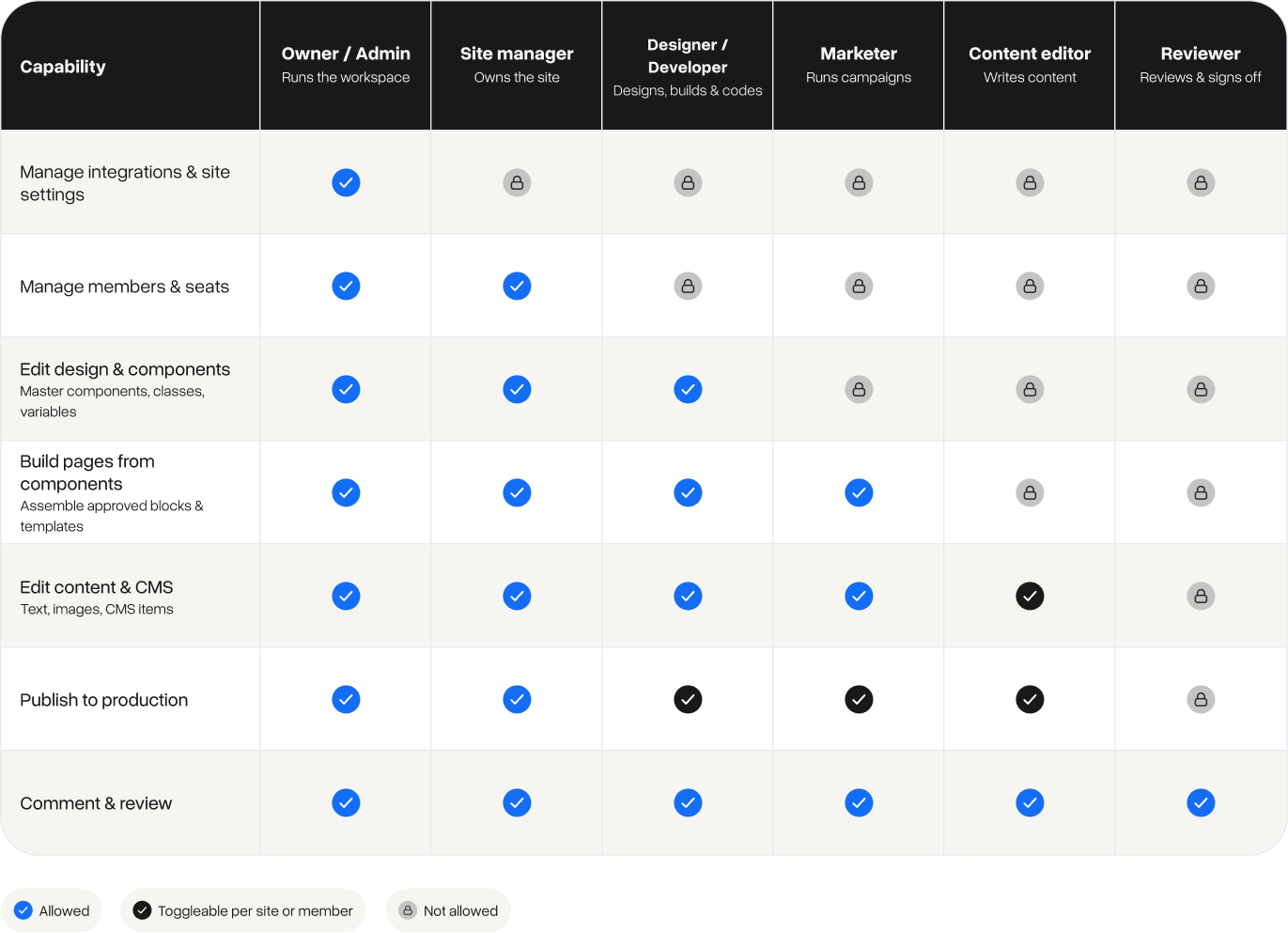
The mechanism is similar to a brand template in PowerPoint: the shapes are fixed, but what goes inside them is the marketing team’s work.
On the second: re-platforming does not eliminate developer effort but reallocates it. On a legacy site, a senior developer’s week is mostly template edits, plugin updates, integration breakage, and the queue of copy changes Marketing logged last sprint. The work the developer was hired for, the work that justifies the rate, is the work most often deferred.
On a Webflow setup, Marketing ships most page-level changes. The developer’s week shifts to work where judgement is the bottleneck: integrating product, asset, CRM and analytics, writing custom embeds beyond the visual canvas, tuning performance and building the AEO scaffolding introduced in Chapter 4.
A €130-per-hour senior developer is more valuable on the integration roadmap than gating a copy change on a product page.
The Mittelstand reallocation, in numbers
Consider a representative German B2B Mittelstand: 500 employees, a five-person marketing team, currently running TYPO3 with 0.5 full-time-equivalent developer support, producing 48 new pages and 240 content edits a year.
On the legacy stack, two marketing team members spend roughly 40% of their time waiting on developer queues. At a fully loaded salary of €75,000 each, that is €60,000 a year in idle capacity. New page production runs at €2,400 of developer time per page, against a marketing alternative of €240. Content edits run at €640 per developer-handled change against €60 per marketing-handled change. (This contrast assumes the legacy template requires developer involvement for any structural edit. A well-templated TYPO3 site reduces the gap, and a heavily customised one widens it.
The condensed three-year line items from the model:
| Cost component | Legacy TYPO3 (3yr) | Webflow Enterprise (3yr) |
|---|---|---|
| Marketing time blocked on developer dependency | €180,000 | €45,000 |
| New pages (48 per year) | €345,600 | €34,560 |
| Content edits (240 per year) | €460,800 | €43,200 |
| Sum | €986,400 | €122,760 Euro |
The Chapter 6 model surfaces €499,640 in three-year savings for this representative Mittelstand case. In this chapter, we isolate the page-level and idle-capacity components of that model: blocked marketing time, new pages, and content edits. Together, these three items account for €863,640 of three-year reallocated spend, with the difference to the Chapter 6 total coming from other cost components covered in the full TCO table in Chapter 6.
A note on DACH Labour Rates
DACH labour-rate context is retained for the buyer who needs the numbers.
| Role | Germany | Switzerland | Austria |
|---|---|---|---|
| Senior web developer (contractor, blended) | €100 to €140 per hour | CHF 120 to CHF 180 per hour | €43,000 to €70,000 per year base |
| AEM, Sitecore, FirstSpirit specialist | €130 to €180 per hour | CHF 150 to CHF 200 per hour | €120 to €170 per hour |
| Loaded internal Head of Digital | €90,000 to €130,000 per year | CHF 130,000 to CHF 180,000 per year | €85,000 to €120,000 per year |
| Senior marketer (loaded) | €45 to €70 per hour | CHF 75 to CHF 110 per hour | €40 to €65 per hour |
As of April 2026. Rates from multiple compiled sources.25Payscale, senior software engineer salary researchpayscale.com/research/CH On legacy stacks such as AEM, Sitecore, and FirstSpirit, the work this cost model cares about — templates, components, and integration-touching changes — is reserved for certified senior developers. Juniors may handle content entry, but they do not run production deployments or alter shared templates on a live instance, which is why the real bill lands at senior-specialist rates, not junior ones.
Hiring runway, kept as context
The DACH IT hiring market is not the central focus of this chapter, and this is not an argument for re-platforming. It is, however, a practical reality for any buyer considering another three-year licence renewal on a platform whose senior practitioners are getting harder to hire.
The Bitkom 202526Bitkom, IT-Fachkräfte Studienbericht 2025bitkom.org/…/bitkom-studienbericht-it-fachkraefte-2025.pdf IT skills study reports 109,000 unfilled IT positions in Germany in 2025, the fourth-highest figure since the survey began in 20. The average open IT role takes 7.7 months to fill, unchanged from 2023. Forty-one per cent of companies report a vacancy duration of seven months or longer. 85% describe the supply of IT specialists as insufficient, and 79% expect the shortfall to widen.
The figure for senior AEM, Sitecore, and FirstSpirit specialists sits at the top end of that distribution. These are platforms where the certification path is long, the installed base in DACH is concentrated, and the labour market for a replacement hire is national rather than local. A team that loses an AEM lead in March is rarely operating at full capacity again before October.
Agencies and in-house teams
A DACH enterprise legacy site typically carries two or three agency relationships. An implementation partner for the AEM, Sitecore, or FirstSpirit deployment at €60,000 to €250,000 per year and a creative or production agency for ongoing campaign work at €40,000 to €150,000 per year. Sometimes an AEO or SEO specialist on a smaller retainer. A loaded Head of Marketing / Digital or similar senior role at €90,000 to €130,000 a year sits over the team, partly to manage those relationships, partly to absorb the developer-handoff overhead.
Widening the builder group re-routes the agency’s spend. The Head of Digital seat moves from agency coordination to AEO performance, conversion experiments, and the integration roadmap. Most magier clients reduce production-agency spend modestly and reinvest the savings in higher-cadence experiments or in AEO content.
A DACH reference: what widening of the group looked like in production
This illustration is a representative composite drawn from engagements magier has run. Figures are representative ranges; no single client is identified.
A DACH industrial Mittelstand in the 400–700-employee range moved its product marketing surface from a heavily-customised TYPO3 site to Webflow Enterprise across two quarters. The marketing team expanded by one demand generation hire. Developer headcount on the website moved from roughly 1.0 FTE to around 0.3 FTE, with the freed capacity reallocated to integration work on the product information system. The migration took eight weeks of active build and four weeks of content migration. Time-to-publish for new campaign landing pages fell from an average of three weeks to under two days. The team now runs two additional campaign cycles per quarter using capacity that previously went to routine site maintenance.
The chapter in one paragraph
The case for re-platforming a marketing surface to Webflow is not that it is cheaper to staff. It is that more of the team can build, the iteration cadence rises, and the same developer team works further up the integration stack. The savings the Chapter 1 cost model surfaces are a by-product of the widening, not the reason for it.
Chapter 4.Why Your Website Is Invisible to AI
A note on terminology: For brevity, we use the term AEO (answer engine optimisation) here to refer to both AEO and GEO (generative engine optimisation) as they are incredibly closely related disciplines with foundations in traditional SEO.
The baseline test
Run ten German-language buyer queries through the five answer engines a DACH Chief Marketing Officer’s prospects actually use. Branded queries. Category queries. Comparison queries. Compliance queries. Submit them in the tone of your ICP, the way a procurement-stage buyer would write them. Then read the answers.
Most DACH enterprise websites do not appear. Not in the citations or the answers themselves.
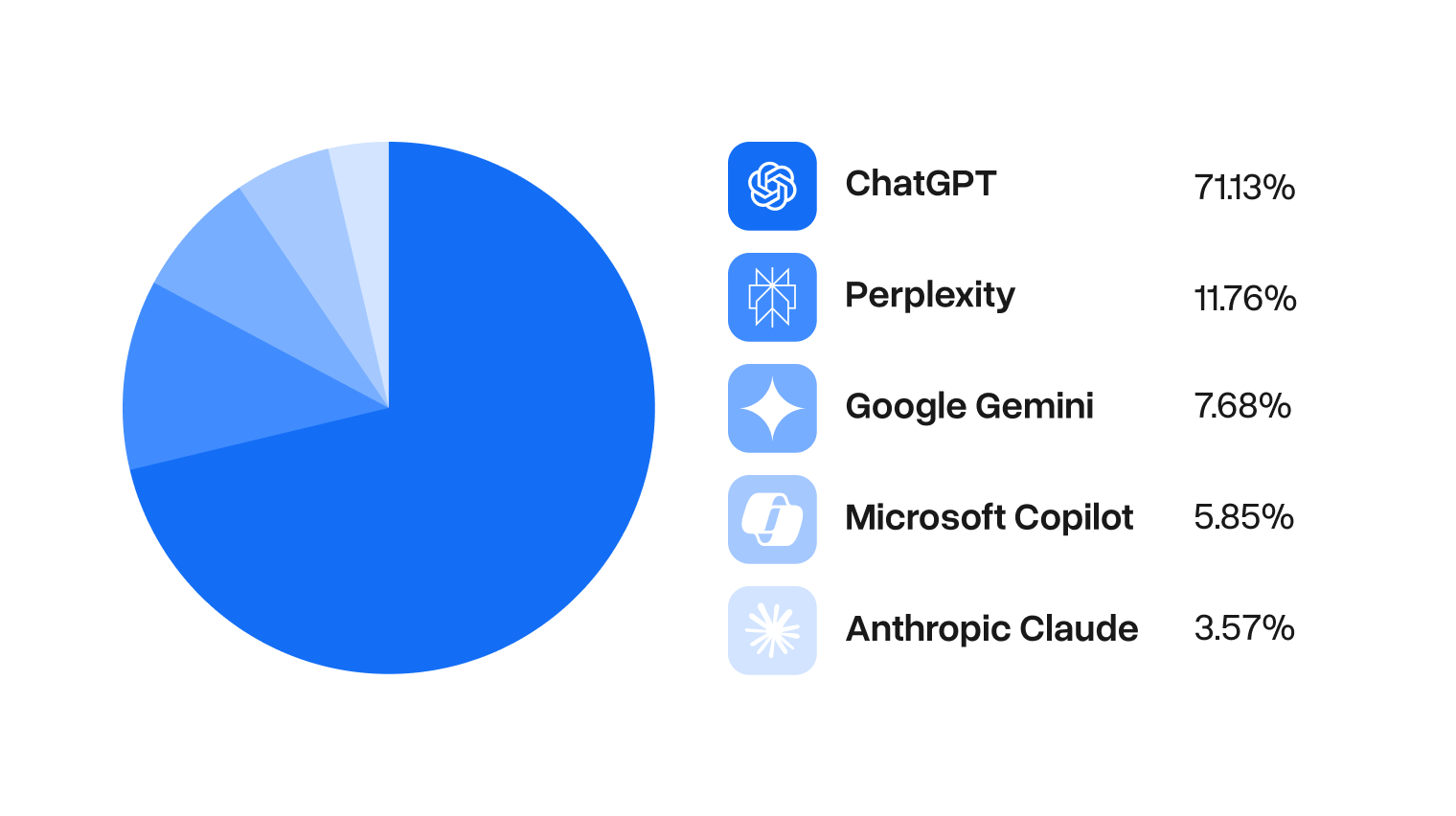
Understanding who is doing the answering helps clarify what visibility you are currently missing. The pattern is consistent across the leading AI chatbot referral traffic to websites. ChatGPT carries 71.13% of the German AI-assistant market in March 2026 per StatCounter Germany 27StatCounter, AI chatbot market share, Germanygs.statcounter.com/ai-chatbot-market-share/all/germany, with Perplexity at 11.76%, Google Gemini at 7.68%, Microsoft Copilot at 5.85%, and Anthropic’s Claude at 3.57%. On compliance and comparison queries, the citations the engines return tend to come from heise.de, t3n.de, Bitkom guidance papers, and law-firm publications.28Source list: Appendix J.
This is not purely an SEO problem. The gap is between a site that ranks in search results and a site that an AI answer engine can read, understand, and confidently cite when composing an answer. The next section diagnoses why most legacy DACH platforms fall short on the second part.
Why your legacy platform is invisible to AI search
Five things go wrong on a typical DACH legacy site. None is individually fatal, but the combination is.
The HTML is not structurally readable
A modern AEM, Sitecore, or FirstSpirit deployment can emit clean semantic HTML, but most do not. After a decade of template customisation, what reaches the browser is a <div> lattice with the visible text wrapped in classes that mean nothing to a parser. The model sees a wall of nested containers and infers little.
Structured data stops at Organisation
At best, most DACH enterprise sites carry a single Organisation JSON-LD block on the homepage and nothing else. It comes without many of the fields that a language model uses to extract a confident citation, which are not on the page.
No llms.txt
The convention proposed by Jeremy Howard in September 2024 had 844,000-plus live implementations as of October 2025, per the Publii summary of BuiltWith data29Publii, llms.txt complete guidegetpublii.com/blog/llms-txt-complete-guide.html. Adopters include Anthropic, Cloudflare, Stripe, Cursor, and Zapier.
Inadvertent crawler blocks
A material share of legacy sites ship a robots.txt that blocks GPTBot, ClaudeBot, or both, often by accident, and often inherited from a generic security template.
Heavy JavaScript rendering
Headless React front ends without server-side rendering produce a blank document body to a crawler that does not execute JavaScript. Google’s crawler does. Most LLM crawlers do not, or do so inconsistently. Static HTML or server-rendered HTML is the requirement. Anything else is a probabilistic bet that the model’s pipeline rendered the page before composing its answer.
The five failures cascade. A site with no schema is hard to cite. A site with no llms.txt is hard to prioritise. A site that blocks GPTBot is impossible to cite. A site rendered client-side is impossible to read. The combination produces what the baseline test surfaces: a site that exists for buyers who already know your name, and is harder to find and less likely to be cited for those who do not.
DACH search context
Google still carries the largest share of DACH discovery on traditional search. Per StatCounter Germany, Google holds 80.05% of all-device search share, while Bing holds 9.99% and Ecosia 1.71%. On desktop, however, Google’s share is lower and Bing’s rises to about 18%, which matters because DACH B2B buyers skew more desktop-heavy than consumers. That does not weaken the case for Google-first SEO; it means a credible DACH AEO program cannot assume Google alone.
DuckDuckGo still relies largely on Bing’s index, so Bing visibility supports discovery there as well. Ecosia should be treated more carefully: since 2025, it has combined Bing, Google, and its own European search infrastructure, so Bing optimisation alone should not be assumed to cover Ecosia visibility. The practical implication is straightforward: Google remains the dominant baseline, but Bing deserves explicit attention because its desktop share is materially higher in the context that many B2B buyers actually use.
The point of citing those numbers in a chapter on AI invisibility is the inverse one. Google is not going away. Optimising for AI engines is additive to existing organic search work, not a replacement for it. The remediation work in Chapter 7 builds on that SEO foundation.
The DACH-sovereign LLMs are the second context point. Aleph Alpha’s Pharia, deployed through the Schwarz Group and STACKIT (BSI-ready, GDPR-native per European Cloud’s February 2026 coverage30European Cloud, Schwarz Group and Aleph Alpha, February 2026european.cloud/2026/02/schwarz-group-aleph-alpha, and the SAP plus Mistral AI alliance announced in SAP’s November 2025 press release31SAP and Mistral AI alliance, November 2025news.sap.com/2025/11/sap-mistral-ai-new-alliance-european-sovereign-ai, occupy the regulated vertical answer-engine slot. They are not in the StatCounter consumer-share figures because they are not consumer products. They are increasingly the answer engine sitting inside a regulated buyer’s procurement workflow, embedded in the same Microsoft 365, SAP, and Schwarz-stack tooling that the buyer already uses.
A site invisible to ChatGPT is also invisible to Pharia. The technical fixes for one apply to the other.
DACH-specific language considerations
Four German-language patterns that affect how AI models read and cite DACH content.
Compound nouns
Digitalisierungsstrategie, Auftragsverarbeitungsvertrag, Barrierefreiheitsstärkungsgesetz, Unternehmenswebsite. These are single semantic units. A model that splits them at the wrong morpheme boundary produces a worse summary. To help the model read your content, provide a parenthetical expansion on first use32magier pro tip.. Auftragsverarbeitungsvertrag (AVV, the data processing agreement). Then the compound thereafter.
DE, AT, CH lexical drift
Januar in Germany and Switzerland becomes Jänner in Austria. Handy in Germany and Austria becomes Natel in Switzerland. Erdgeschoss becomes Parterre in Switzerland. Per the Argos Multilingual review of German SEO33Argos Multilingual, German SEOargosmultilingual.com/blog/german-seo, pan-DACH copy that ignores these distinctions reads as outsider copy to a Swiss or Austrian buyer and produces lower-confidence model citations.
Configure per locale via Webflow Localization, or accept that readers in one of the three markets will notice the difference.
Sie and Du consistency
B2B and enterprise content use formal Sie throughout. Mixing Sie and Du across pages confuses a model summarising the brand voice. Developer-facing content may legitimately use Du. The discipline is consistency within a defined surface.
E-E-A-T and Impressum
German E-E-A-T signals (experience, expertise, authoritativeness, trustworthiness) are stricter than the global pattern. Author bylines link to credentialed profiles. Inline citations carry a German source (Quelle: BVDW, 2025). The Impressum is a § 5 DDG / § 5 ECG legal requirement and a model trust signal in the same act. A site without an Impressum fails compliance and citation in the same step.
The robots.txt question
The robots.txt question is no longer a security choice. How you configure it determines whether AI answer engines can find and cite your content. The list of AI crawlers at DACH enterprise sites now needs to make deliberate decisions about multiple distinct AI crawlers, each with different owners (OpenAI, Anthropic, Perplexity, Google, Apple, Meta, ByteDance, Common Crawl, Amazon, DuckDuckGo) and purposes (training, search index, live retrieval). Some attribute the source. Some do not. Some respect robots.txt. Perplexity has been reported (per multiple industry sources, including the Wired analysis of June 202434Wired, June 2024 analysis of Perplexitywired.com/story/perplexity-is-a-bullshit-machine) to operate retrieval crawlers that do not always respect robots.txt directives.
The strategic answer is to allow the crawlers that attribute, deny the crawlers that train silently, and apply CDN-level enforcement against crawlers that do not respect the file. The full matrix and the Scenario A versus Scenario B decision sit in Chapter 7.
Ignoring this question is not a neutral position. The default robots.txt that ships with most legacy CMS templates was written before answer engines existed. Whatever it currently says about AI crawlers, it says by accident.
Six tests to run on your own site today
These six tests take around 30 minutes and will tell you whether your site has a baseline AEO problem. They are not exhaustive, but they are enough to know if there is work to do.
-
The query test
Pick five buyer queries you would expect a prospect to ask. Run each on ChatGPT, Perplexity, and Gemini. Note whether your site is cited, whether a competitor is cited, and which third-party publication the answer rests on. If you appear in zero of fifteen runs, the rest of this list is mandatory.
-
The view-source test
Open your highest-traffic product or service page. View source. Count the <div> density between the opening of the body and the first paragraph of visible text. If a model has to traverse eighty divs to find the answer to “what does this company do?”, the answer is buried.
-
The schema test
Run the page through Google’s Rich Results Test35Google Rich Results Testsearch.google.com/test/rich-results) or the Schema Markup Validator36Schema Markup Validatorvalidator.schema.org. Count the structured-data types present. If the only type returned is Organisation, you have the minimum, not the working set.
-
The llms.txt test
Type yourdomain.tld/llms.txt into a browser. If you get a 404, you do not have one; adding one is one to four hours of work and carries minimal downside risk for a marketing site, per the magier blogpost37magier, how to add llms.txt to Webflowmagier.com/blog/how-to-add-llms-txt-to-webflow.
-
The crawler-policy test
Read your robots.txt. Note every line that mentions GPTBot, ClaudeBot, PerplexityBot, OAI-SearchBot, ClaudeBot, Google-Extended, or CCBot. If the policy was set more than 18 months ago, it predates the live-search behaviour of the current generation of engines and needs a review regardless of whether you end up changing anything.
-
The render test
Load the page with JavaScript disabled. Most browsers carry a developer-tools toggle for this, or use view-rendered-source.com38View Rendered Sourceview-rendered-source.com to compare server-rendered against client-rendered output. If the visible content disappears, the page is invisible to any crawler that does not execute JavaScript, which includes most LLM crawlers.
Most DACH enterprise sites are not invisible by choice. The platform, the template, and the robots.txt file are making that decision by default. If AEO is the priority for the next two quarters, Chapter 7 covers the full remediation stack and a 90-day plan that a marketing team can run.
“Building the website itself will become the default — anyone will be able to do it. The real shift is toward search visibility and AI adoption, and security and privacy become the real differentiators.”
Section IIThe Visual Web
Eighteen months ago, the marketing team’s website work moved at the rhythm of a developer’s release calendar. The campaign happened on Webflow. The corporate site is built on AEM, Rezolve FirstSpirit, TYPO3, or Sitecore. Two cadences, two budgets, two cultures, one logo at the top. The chapters in this section are about closing that gap. Not by replacing every system that earned its place over twenty years of DACH-enterprise IT, but by giving the marketing team its own operating system. A website platform that the marketing team actually runs.
| Chapter 5 | Design Is the New Code |
| Chapter 6 | The TCO Truth |
| Chapter 7 | From SEO to AEO. The Next Frontier |
| Chapter 8 | Why Webflow Wins (and Where It Doesn’t) |
| Chapter 9 | The Optimise Loop |
Chapter 5.Design Is the New Code
Visual development stopped being a downgrade somewhere around 2022.
Among the objections to Webflow that surface in DACH steering committees, the most persistent is the same one that delayed Figma adoption in the same boardrooms five years earlier: that visual tools compromise the codebase. The assumption being that if you cannot see the angle brackets, the work is shallow, and a marketing person clicking around in a browser cannot, by definition, create production-grade output.
This chapter argues the opposite and backs it up with code output and real examples.
What Webflow’s Designer actually emits
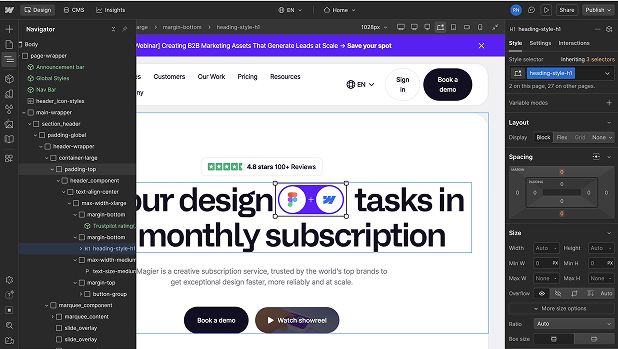
Open the developer tools on a Webflow Enterprise site. The output is semantic HTML5: <header>, <nav>, <main>, <article>, <section>, <footer>, with ARIA roles applied only where they add value. Class names are the design-system tokens written by the designer, not auto-generated hashes. CSS custom properties carry the brand’s colour, typography, spacing, and motion variables. The output validates against the W3C HTML validator on a clean build.
This is not the kind of output you see from WordPress page-builder plugins, where the page tree becomes a forest of nested <div> elements, and the first accessibility audit already fails. It is also not what a hand-coded React app typically produces when accessibility is not an explicit priority in the build. It is what a designer working in a structured tool produces when the tool flags, and strongly discourages, decisions like using a <span> where an <h2> belongs.
The accessibility consequence matters. Under the BFSG, the accessibility statement is often the most visible compliance indicator, but the underlying legal requirement is substantive accessibility in practice, typically assessed against WCAG 2.1 Level AA and EN 301 549 v3.2.1. Tools that generate semantic HTML and accessibility-friendly output by default give teams a meaningful advantage because heading structure, form labelling, keyboard navigation, focus management, and similar requirements are easier to implement and maintain when they are built into the production environment. But tooling does not guarantee compliance. Even strong platforms fail accessibility audits when teams neglect alt text, colour contrast, captions, accessible forms, or document accessibility, while experienced developers can still achieve compliance with fewer accessibility-focused tools, usually at higher cost and effort. The practical conclusion is that accessibility-oriented tooling materially reduces compliance risk and remediation cost, but it does not remove the need for testing, review, and ongoing accessibility governance.
One page, two timelines
On AEM, the honest answer depends on what already exists. If the component library covers everything, an author can assemble the page in days; that concession matters, and it is also rare in practice, because campaign pages are precisely the pages that ask for something the library does not have. The moment one component is missing, the work routes through the implementation partner: HTML templates and Sling models committed to the Maven build, dialog definitions reviewed by the AEM architect, pull request, code review, QA on the staging Author instance, replication to Publish, smoke test, BFSG accessibility review, legal sign-off, go-live. Six to ten weeks is realistic for a functioning team inside a regulated governance stack. A full quarter happens, and not rarely, when the implementation partner is sharing capacity across clients, and changes ride a monthly release train.
On Webflow, the same work runs for a week. Day one, the designer assembles the page in the Designer from the brand’s existing component set; if a component is missing, the designer builds it the same day instead of filing a ticket. Day two, the marketing manager populates the CMS Collection and the German and English variants. Day three, accessibility review and German-language proofread. Day four, staging review by Brand and Legal. Day five, publish. The standards are identical, as are the governance checks. What collapses is the time spent waiting for engineers to move between them.
The gap is not Webflow being faster than AEM in the abstract. It is that AEM’s value proposition (deep integration into Adobe Experience Cloud, personalisation through Adobe Target at DAX-40 scale, multi-site management across dozens of country sites) is not what a five-component campaign page needs. All it needs is a week, not ten.
AEM still wins where AEM’s depth is genuinely required. Appendix B carries the platform-by-platform verdict. This chapter carries the other one: where AEM’s depth is not required, choosing it anyway is paying ten weeks of operating cost for a page that needed one.
What Webflow gives your team
For DACH IT leaders reading along, here is what Webflow offers a development team that wants to keep its ownership of the work.
Custom code embeds
Block-level and site-level. Useful for the analytics tag, the consent management script (OneTrust, Consentmanager, Usercentrics, see Appendix A), the chatbot widget, or the localised legal disclaimer.
Application runtime alongside Webflow-hosted pages, for the cases where dynamic logic is needed and a third-party API is not enough.
Webflow’s native component library feature is found under the Libraries panel in the Designer. Shared Libraries live inside a single Workspace and are available across all sites within that Workspace; they cannot be shared across separate Workspaces. The right tool for a brand system applied to multiple regional or product sites within one organisation. Different from the Webflow Marketplace Libraries39Webflow Librarieswebflow.com/libraries, which sell prebuilt design layouts to anyone.
API v2 and the Data API
Programmatic read and write access to CMS Collections, form submissions, and e-commerce orders. Useful for headless escape-hatch use cases where a content team needs to feed Webflow from a PIM or a translation memory.
Headless escape hatch
When a project requires a separate front-end framework, Webflow can act as the headless content backend through its API while the front-end ships as a Next.js or Nuxt application. This is rare for marketing surfaces and common for product surfaces. The point of mentioning it is that the option exists when it is needed, but most projects discover that it is not.
Quality guaranteed, not assumed
Visual tools do not enforce quality on their own. A bad designer with a structured tool ships bad work faster. The magier model therefore puts a four-eyes review on every task before publication: a project manager who did not build the page checks composition, hierarchy, accessibility contrast, typography, and brand-system fidelity. Most defects that would otherwise reach production are caught in this review, not in the build pipeline. It is a non-negotiable step in our delivery model, and one we recommend for any internal Webflow project that runs at volume.
For client-side teams who want to operate Webflow without a partner, the same review function lives in a content lead with brand-system authority and a designer with art direction responsibility. The review takes ten to twenty minutes per page. It is the difference between Webflow at quality and Webflow at volume.
Where the objections come from
Visual tools compromise the codebase.’ The objection has a legitimate origin. Squarespace sites, WordPress pages built on stacked plugins, early Wix templates; all of them produced code that justified the criticism. The objection earned its weight there.
Webflow’s output, in 2026, sits in a different category. Semantic HTML5, accessible by default, with a clean separation between content (CMS Collections), structure (the Designer’s component tree), and presentation (CSS variables and tokens). Because Webflow generates clean, unbloated output, LCP typically falls within Google’s Core Web Vitals ‘good’ range of under 2.5s on well-configured sites40web.dev, Optimize LCPweb.dev/articles/optimize-lcp though that remains a function of how the site is built, not the platform alone. It is what a thoughtful engineering team would build if their job were the marketing site and they had a year to build the tooling.
There are workloads Webflow’s output does not serve. Real-time server-side personalisation against a customer-data platform with millisecond response budgets. Pure content-as-API delivery to a fleet of native applications. Multi-tenant publishing where every tenant runs a different schema. These are AEM’s territory, Sitecore’s territory, and Contentful’s territory. They are not the territory of a corporate marketing site, a product launch microsite, an event landing page, or a careers hub. Most of what a DACH marketing team ships sits in the second list, not the first.
Reader takeaway
The phrase ‘Visual development’ has carried too much shame for too long in DACH enterprise IT. The argument against it made sense in 2014. It does not in 2026. Treat the question “Is your codebase clean?” as a separate question from “Did a developer type every character of it?”. The first is what matters. The second is a trade you make for execution speed when the work permits it. And for the marketing surface, the work permits it.
Permission to stop treating ‘Visual’ as a synonym for ‘Shallow’.
Chapter 6.The TCO Truth
The three-year TCO of a legacy DACH CMS estate runs three to four times the cost of a Webflow. The Forrester TEI headline of 332% ROI understates the DACH-specific difference because the model does not price in BFSG remediation, NIS2 documentation, or the year-on-year scarcity premium on AEM and Rezolve FirstSpirit developer rates.
This chapter runs the cost model in plain terms. The steering committee meeting where the number gets used has thirty minutes for the website conversation, and the financial side of it gets six.
The Forrester headline
Forrester’s Total Economic Impact study of Webflow Enterprise41Forrester, Total Economic Impact of Webflow Enterprisewebflow.com/resources/report/forrester-tei first published in September 2024 and commissioned by Webflow and conducted on a composite organisation derived from interviewed Webflow customers, returned six numbers that anchor the financial conversation:
reduced from roughly 22 people to 6
Forrester’s TEI methodology uses a composite organisation in interviews with customers, applies risk-adjusted estimates, and discounts to present value at 10%, which is a standard practice for CFO-grade reading. The numbers are not vendor marketing; they are the methodology Forrester applies to every TEI study, including the equivalents commissioned by Adobe, Sitecore, and Salesforce on their own platforms. The number to compare against is, for example, Forrester’s TEI of Adobe Experience Cloud, which carries a different ROI on a different cost base.
The DACH-specific footnote: the Forrester sample is global. The DACH labour-rate premium and the DACH regulatory remediation cost are not modelled. Both push the DACH difference higher than the global headline.
The worked Mittelstand profile
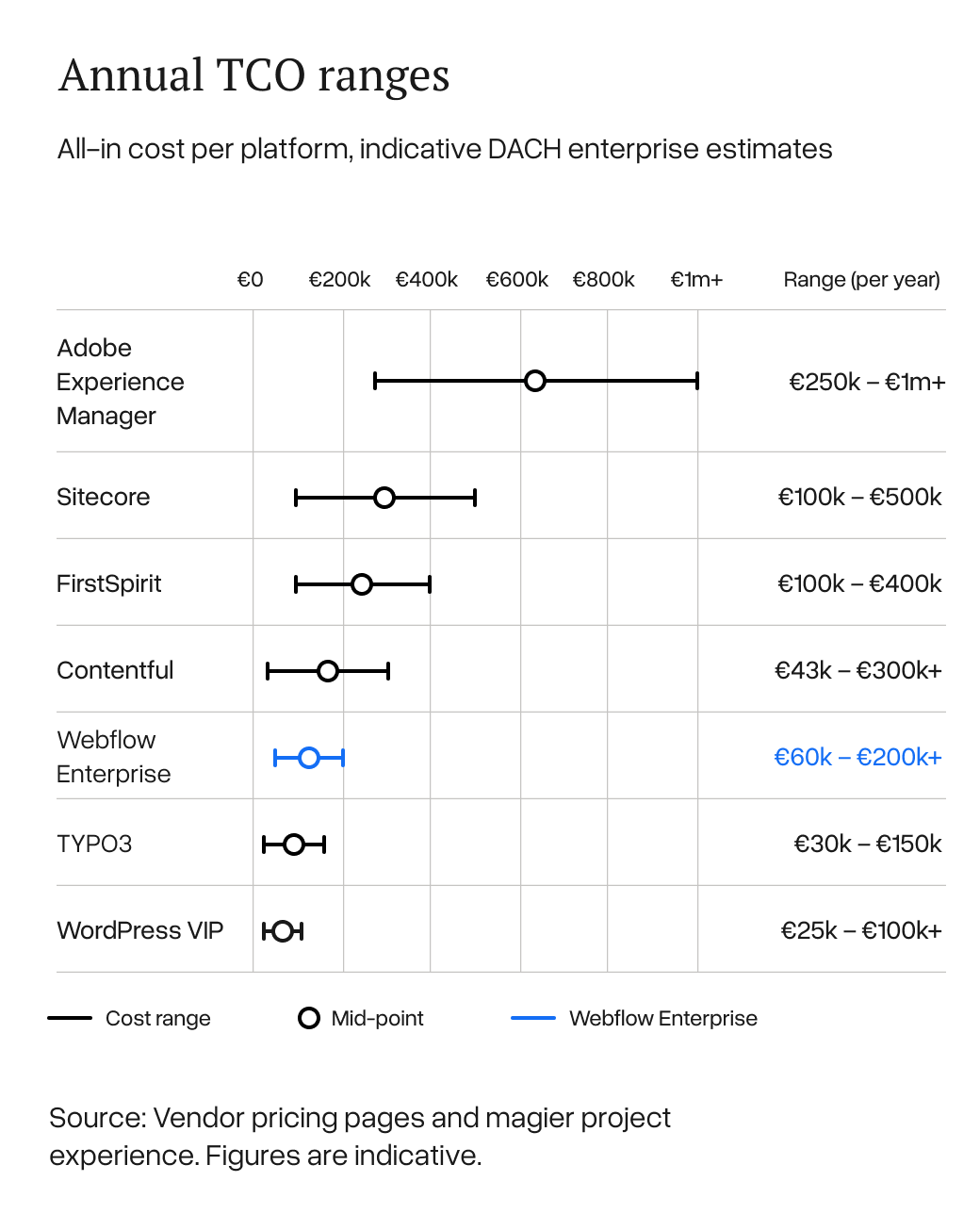
A representative DACH Mittelstand, drawn from the AEO/TCO research dossier and stress-tested against the magier project portfolio. Three-year horizon. Marketing-surface scope: corporate site, four product-line subsites, careers, PR newsroom, two regional event microsites per year. German and English at a minimum, with French or Italian for the Swiss subsidiary. Approximately 600 to 1,200 published pages. Content velocity: 40 to 80 page changes per month, two campaign launches per quarter.
| Line item | Legacy CMS three-year cost | Webflow three-year cost |
|---|---|---|
| Licence fees (e.g., AEM Sites / Sitecore) / Subscription Fee | €120,000 | €60,000 (Webflow Enterprise + add-ons; ~€20,000/year × 3) |
| Implementation (initial build or re-platform) | €380,000 modelled (€150,000–€600,000+ across the six platforms) | €120,000 |
| Maintenance and security patching | €114,000 (≈10% of the initial build per year, × 3 years) | Equivalent to €18,000 (included in Licence fee) |
| BFSG remediation cycle | €60,000 | €24,000 |
| Potential NIS2 supply-chain risk documentation and BSI registration | €18,000 | €4,000 |
| Risk reserve (regulatory, re-platform, scope creep) | €26,400 | €10,760 |
| Three-year total | €718,400 | €218,760 |
| Three-year saving | €499,640 | |
| ROI | 228% |
The 228% here is the worked-example ROI (three-year saving / Webflow three-year cost). The 332% cited above is the Forrester global composite TEI on a different sample and basis. They are not the same number and are not meant to match.
Internal FTE allocation is excluded from the model. In the typical Mittelstand engagement, the marketing team supplies a project owner; there is little or no in-house IT or developer share on the client side, and the agency cost already sits in the implementation and maintenance lines. Where an internal share does exist, treat it as part of the initial build.
Source notes: legacy line items are a composite of the NITSAN Tech TYPO3 engagement bands (€80–€150 per hour DACH agency work, €10,000–€40,000 mid-level corporate engagements, €40,000–€150,000+ enterprise platforms), the NITSAN TYPO3 agency cost guide, Abbacus Technologies 2026 Germany rates for senior contractors (€100–€140 per hour), and magier project experience. NITSAN’s delivery roots are in India, and its published prices sit at the low end of the DACH market; the modelled figures above therefore sit above the NITSAN bands. All sources verified 12 June 2026.
The DACH labour maths
Chapter 3 carries the detail. The summary line: in 2026, DACH IT vacancies stand at 109,000 in Germany alone with an average vacancy of 7.7 months, per the Bitkom IT-Fachkräfte study. AEM-certified contractors operate at €140 to €220 per hour on average in 2026, FirstSpirit at €120 to €180, TYPO3 senior at €100 to €150 (NITSAN Tech, Abbacus Technologies Germany, Abbacus Technologies Switzerland). The Webflow-skilled designer-developer band runs €70 to €120 per hour and is significantly more available at the experienced end42Bitkom IT-Fachkräfte 2025; NITSAN Tech TYPO3 agency guide; Abbacus Technologies Germany and Switzerland developer cost breakdowns, 2026..
The labour line is where the AEM and FirstSpirit cost curves rise year on year. It is not a stationary input. It is the most sensitive variable in the legacy-CMS column, and it is the variable that procurement teams routinely under-forecast.
Build, buy, or both?
For a CFO-grade reader, the decision frame at the platform level comes down to three lines.
-
Buy a website platform
when the marketing surface is the workload and the requirements are within Webflow’s depth (the substantial majority of DACH enterprise marketing surfaces, per Chapter 8). This is the case the worked profile above covers.
-
Buy and integrate
when the marketing surface needs to read from a PIM, DAM, CRM, or product database. Webflow plus a third-party integration layer (the marketing CMS sits on Webflow, the data spine sits in the PIM or CRM). The TCO premium on top of pure Webflow is approximately 15 to 25%, significantly below the cost of staying on a legacy platform.
-
Build (or stay built)
when the workload is genuinely AEM-territory or Contentful-territory; see Appendix B for the platform-by-platform verdicts. The TCO conversation is moot because Webflow is not the right platform.
Where the Webflow TCO edge disappears
Three workloads where the Webflow line in the table above does not hold.
Multi-brand federation at 40-plus sites with on-premise hosting requirements
The federation surface remains, but the on-premise constraint is incompatible with Webflow’s hosted-only model. Smaller, static Webflow projects can be exported or self-hosted to some extent, but the full Webflow experience relies on Webflow’s hosted infrastructure.
Adobe stack integration
When the marketing operations depend on Adobe Experience Cloud’s integrated personalisation, AEM Forms, and AEM Assets at DAX-40 scale, the TCO conversation looks different, and AEM remains the rational choice. In the broader Adobe Experience Cloud context, AEM is increasingly deployed alongside Adobe Experience Platform (AEP) for unified customer data, Adobe Analytics for reporting and audience insights, Adobe Target for A/B testing and personalisation, and Adobe Journey Optimizer for cross-channel campaign orchestration. Enterprise readers evaluating AEM should account for the licensing and integration costs of these adjacent products, as they are commonly sold and deployed as a suite rather than standalone.
Pure headless content as API delivery to native applications
Contentful’s per-API-call model is purpose-built for this workload. Webflow’s API v2 covers simpler headless patterns but is not what the platform is built around.
These workloads are a minority of the DACH enterprise marketing surface. Webflow’s TCO advantage holds for the substantial majority of DACH enterprise marketing surfaces, not these edge cases.
Reader takeaway
A CFO-grade number you can plug into your next CAPEX conversation before the steering committee meets.
Three-year savings of €499,640 on the worked Mittelstand. Forrester TEI of 332% ROI on the global composite, understated for DACH. The spreadsheet is downloadable as the Appendix C companion.
Chapter 7.From SEO to AEO. The Next Frontier
This chapter is the practical companion to Chapter 4. If you have not read it yet, it is worth starting there.
The DACH web’s next discovery surface is the answer engine, not the search engine. Being citable by an LLM is a technical practice, and Webflow is structurally closer to ready than any legacy CMS in the DACH market.
“Every marketing leader I’ve spoken with recently has AI, AEO and Agentic Workflows at the top of their agenda. The conversation has moved on from which tools to use. CMOs are now asking how AI changes the way buyers discover and evaluate them. Answer Engine Optimisation isn’t a future consideration. It’s where the competitive ground is shifting right now.”
Chapter 4 made the diagnostic case: most DACH enterprise websites are increasingly invisible to AI. ChatGPT holds 71.13% of the German AI-assistant market43StatCounter, AI chatbot market share, Germanygs.statcounter.com/ai-chatbot-market-share/all/germany, Perplexity 11.76%, Gemini 7.68%, Copilot 5.85%, Claude 3.57% (StatCounter, March 2026). Cloudflare reported on 1 July 202544Cloudflare, From Googlebot to GPTBot: who’s crawling your site in 2025blog.cloudflare.com/from-googlebot-to-gptbot-whos-crawling-your-site-in-2025 that GPTBot crawl volume rose 305% year on year, with 14% of top-10,000 domains that publish a robots.txt including AI-crawler rules. The category-defining question for a 2026 Chief Marketing Officer is no longer ‘Where do we rank on Google?’ but “What does the answer engine cite when someone asks about our category?”.
This chapter covers six concrete moves to improve AEO readiness, each sized by implementation hours. Most are straightforward to implement without a developer.
Define AEO
Answer Engine Optimisation is the discipline of making content structurally comprehensible and authoritative to large language models, so they cite it when generating answers to user questions in their category. It is adjacent to SEO, not in competition with it. The signals overlap (semantic structure, authoritative content, technical performance), but the audience is different: a probabilistic retrieval-and-reasoning system, not a deterministic ranking algorithm. The optimisation pressure shifts from ‘Be in the top ten’ to ‘Be the source the model trusts.’
The Webflow AEO stack, seven layers
1. Semantic HTML5, emitted natively
Chapter 5 covers what Webflow’s Designer outputs. The relevance to AEO: LLM crawlers parse semantic markup faster and with higher confidence than they parse layers of <div> containers. Headings, articles, navigation regions, and footers are all in their proper elements. This is a free win on Webflow because the platform produces it by default.
2. Structured data strategy (Schema.org, DE-localised)
JSON-LD blocks added to the page head describe the entity (Organization), the offer (Product, Service), the answer pattern (FAQPage, HowTo, QAPage), the editorial signal (Article, TechArticle), the navigation surface (BreadcrumbList), and the local presence (LocalBusiness). DACH-localised properties matter.
{
  "@context": "https://schema.org",
  "@type": "Organization",
  "@id": "https://example.de/#organization",
  "legalName": "Beispiel Industriegruppe GmbH & Co. KG",
  "name": "Beispiel",
  "url": "https://example.de",
  "logo": "https://example.de/logo.png",
  "vatID": "DE123456789",
  "identifier": {
    "@type": "PropertyValue",
    "propertyID": "Handelsregister",
    "value": "HRB 12345, Amtsgericht Düsseldorf"
  },
  "address": {
    "@type": "PostalAddress",
    "addressCountry": "DE",
    "addressRegion": "Nordrhein-Westfalen",
    "addressLocality": "Düsseldorf",
    "postalCode": "40213",
    "streetAddress": "Beispielstraße 1"
  },
  "sameAs": [
    "https://www.linkedin.com/company/example",
    "https://www.wikidata.org/wiki/Q00000000"
  ]
}
3. CMS atomisation
Every data unit (price, metric, author, certification, product specification) lives as a CMS Collection field, not as an unstructured text block inside a rich-text body. The reasoning is twofold. First, atomised fields are queryable and reusable, so the same value renders inside the JSON-LD and inside the visible body without divergence. Second, LLM crawlers extract atomised fields with higher confidence than they extract values embedded in prose. A product’s certified WCAG conformance level rendered through <meta property="dcterms:conformsTo"> is a reliable signal for LLM crawlers. The same value buried in a marketing paragraph is harder for a crawler to extract reliably.
The migration consequence: pages that read as text blobs on a legacy CMS need to be re-modelled as Collection records on Webflow. This is a one-time content engineering exercise, scoped in the discovery phase, and is the single largest non-design item in a Webflow migration budget. Factoring this in at the discovery phase prevents it from becoming an unplanned cost mid-migration.
4. Server-rendered content
Webflow publishes static HTML at build time and serves it from a CDN. LLM crawlers, such as search engine crawlers, read static HTML reliably. But they struggle with content rendered client-side by a React or Vue application without server-side rendering. A headless React stack without SSR is invisible to most LLM crawlers in the same way that early single-page applications were invisible to Googlebot in 2012.
This is a structural advantage Webflow holds against the headless-without-SSR pattern. It is not an advantage against AEM Sites or TYPO3 (both of which also publish server-rendered HTML), but it is a clean win against the composable DXP stack with a React front end that has become common since 2020.
5. llms.txt adoption
A draft community standard, modelled loosely on robots.txt, that lets a site provide LLM-readable summaries of its key pages and content paths. Origin: the llmstxt.org specification by Jeremy Howard. The file lives at /llms.txt on the domain root and points the LLM at a hand-picked set of canonical URLs with brief context.
Adoption is not yet universal among model providers but is rising. Adding the file is one to four hours of work and carries minimal downside risk for a marketing site. Test it with the simplest possible diagnostic: type yourdomain.tld/llms.txt into a browser. If you get a 404, you do not have one.
6. Webflow AEO for Enterprise
Webflow AEO is an enterprise-only feature set that lets you measure how your brand appears in AI “answer engines,” get AI-generated, prioritised recommendations to improve that visibility, and then implement those fixes directly inside Webflow. It currently combines AI answer visibility tracking, AI bot crawl monitoring, and conversion-connected reporting with AI agents that surface and prioritise site-wide actions like fixing metadata gaps, schema errors, and broken links, so your content is easier for LLMs to understand and cite at scale.
For DACH customers, the readiness sequence is to apply the first five layers first, then enrol in the AEO Enterprise programme as a multiplier on a structurally ready site. The AEO product does not fix non-semantic markup or non-atomised content; it accelerates the iteration loop on a site that has the foundations in place.
7. Webflow’s native schema tooling and automation
Webflow now ships a native schema markup field on every page, so the default pattern is no longer a custom code embed. Schema lives under Page settings → Schema markup, where you either generate JSON-LD with Webflow AI in one click or paste your own markup; on publish, it renders into the page head for static and Collection (CMS template) pages alike.
For CMS-driven schema, the recommended pattern is to treat structured data as an extension of your content model rather than a free-hand code block. On Collection pages, Webflow AI can auto-populate schema from the obvious dynamic fields (name, price, image), or you can bind specific Collection fields directly inside the schema field so that each item publishes a unique Product, Article, or FAQ entity. This keeps the JSON-LD in lockstep with your CMS and prevents the schema rot that comes from copying static snippets between templates.
Organization-level schema works slightly differently. The native schema field is scoped per page, so the canonical Organization entity still belongs on the homepage, which acts as the brand root for both search engines and answer engines. If you prefer to inject Organization once across the entire site, the global custom code embed remains valid and is still respected by crawlers, but you should avoid running a global embed and a per-page Organization schema in parallel to prevent duplicate or conflicting structured data.
At enterprise scale, you do not want to manage schema one page at a time. Webflow’s Data API lets you read and update schema programmatically across projects, including locale-aware variants for multi-language sites. This is the path for agencies, in-house SEO teams, and AEO tooling vendors: the AEO suite surfaces gaps and inconsistencies in your structured data graph, then you use the API to apply bulk fixes and keep schema in sync with upstream systems like product catalogs or PIMs.
The 14-crawler robots policy
A reference card, drawn from the AEO/TCO research dossier and refreshed against the 2025 Cloudflare report. The strategic answer to the LLM-crawler question is to allow the crawlers that attribute citations and deny the ones that train silently without attribution.
| Crawler | Operator | Default Webflow recommendation | Reasoning |
|---|---|---|---|
| GPTBot | OpenAI | Allow with rate limits | Trains GPT models; partial citation in ChatGPT search |
| OAI-SearchBot | OpenAI | Allow | Powers ChatGPT search citations |
| ChatGPT-User | OpenAI | Allow | User-initiated browsing inside ChatGPT |
| ClaudeBot | Anthropic | Allow with rate limits | Trains Claude; partial Claude.ai search citation |
| PerplexityBot | Perplexity | Allow | Powers Perplexity citations and answer engine |
| Perplexity-User | Perplexity | Allow | User-initiated browsing inside Perplexity |
| Google-Extended | Allow if Gemini citations matter; deny if training-only is the concern | Toggle separates Search indexing from Gemini training | |
| GoogleOther | Allow | Standard research and product crawls | |
| Bingbot | Microsoft | Allow | Standard search; powers Copilot |
| CCBot | Common Crawl | Case-by-case | Open dataset feeding many models |
| Bytespider | ByteDance | Deny (DACH default) | Doubao trains here; weak attribution |
| Meta-ExternalAgent | Meta | Im Einzelfall | Training für Llama und Meta AI; kaum Quellenangaben |
| Meta-ExternalFetcher | Meta | Zulassen | Nutzerabruf für Meta-AI-Antworten; teils Quellen |
| Amazonbot / Amzn-SearchBot / Amzn-User | Amazon | Allow | Alexa+ retrieval; weak public AEO surface today |
| Applebot-Extended | Apple | Allow | Apple Intelligence; opt-out from training distinct from search indexing |
The implementation in Webflow lives in Site settings → SEO → Indexing45Webflow Help Center, Robots.txthelp.webflow.com/hc/en-us/articles/33961440681491-Robots-txt. The crawler list changes frequently enough to warrant a quarterly review.
The DACH-specific AEO layer
LLMs are English-centric. Their training corpora are dominated by English text, and German, although one of the best-resourced non-English languages, holds a minority share. For AEO, this matters less as a quality problem than as a supply problem. When an answer engine assembles a German-language answer, it draws on a far thinner pool of well-structured German sources than the same question would surface in English, and the answers show it: DACH category questions regularly fall back on English-language sources, or serve German-German vocabulary to Austrian and Swiss audiences. That thinness is the opportunity. Competition for citations in German is lower than in English, and terminologically precise, well-structured German content wins a disproportionate share of them. The mitigations are editorial and structural, not platform-level, and the magier DACH AEO playbook is built around exactly this principle. Five patterns follow.
German compound nouns
German concatenates where English uses adjective-noun pairs: Datenschutz-Folgenabschätzung is one term, while data protection impact assessment is four words. Modern LLMs understand compounds without difficulty; the problem sits one step earlier, in retrieval. A buyer asks the answer engine using the acronym (DSFA), the English term, or a spelling variant, and a page that carries only one form of the term matches weakly against the others. German orthography multiplies the variants: the GDPR’s official German text hyphenates (Datenschutz-Folgenabschätzung) while common usage often does not. The fix is a terminology discipline that was always worth having: carry the full set on first use, Datenschutz-Folgenabschätzung (DSFA, data protection impact assessment), and maintain a glossary, in Webflow, naturally a CMS Collection, that maps each term to its acronym, spelling variants, and English equivalent. It serves human readers first; that it widens your retrieval surface is the bonus.
DE / AT / CH vocabulary drift
The same concept carries different words across the three markets: a quote is an Angebot in Germany and an Offerte in Switzerland, January is Januar in Germany and Jänner in Austria, and Austrian invoices are fakturiert where German ones are gestellt. AI answers default to whatever dominates the training corpus, which is almost always German-German, so Austrian and Swiss audiences get served vocabulary that reads as foreign. The mitigation is the localisation work that was always correct: country-coded paths (/at/, /ch/) with hreflang tags, and genuinely Austrian or Swiss content where the audience justifies it. Sites that skipped this used to lose a little warmth; in answer engines, they lose the citation to whoever did the work.
Sie and Du consistency
Brand voice in DACH B2B sits on Sie; B2C splits, with younger consumer brands on Du. In our project work, AI assistants describing a brand tend to mirror the address form they find on the brand’s own site, and a site that mixes Sie and Du across pages hands them a coin to flip. We label this an observation, not a law. The mitigation costs nothing either way: a style guide that locks the address form per locale, enforced in editorial review before anything publishes. Brand consistency was reason enough before any machine read a website.
Author E-E-A-T signalling
Experience, Expertise, Authoritativeness, Trustworthiness is Google’s quality-rater framework, an SEO staple, and neither a direct ranking factor nor an exposed score. It still describes what retrieval systems reward: identifiable sources. For DACH, the practical signals are unusually concrete because the law already forces the strongest one. A visible Impressum link in the footer is a legally mandated identity statement that no other market requires of its companies and a gift for machine attribution. Add a named author with role and credentials in the byline, and an Organization schema entity linked to the page’s Article schema via the publisher relationship, and the source of every claim on the page is machine-readable.
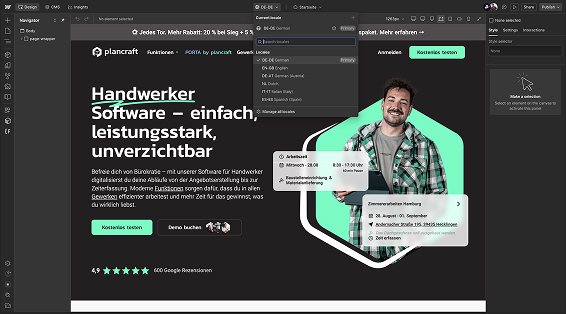
Reader takeaway
Run the six baseline tests on your own site today. Check whether your structured data renders server-side, whether AI crawlers are allowed in robots.txt, and whether your Impressum and named-author bylines are machine-readable. Use country-coded paths (/at/, /ch/) with correct hreflang tags to avoid vocabulary drift across DACH markets. Enforce a consistent address form (Sie or Du) with a style guide before content reaches production.
plancraft: Webflow as the foundation layer for fast, scalable company growth

plancraft builds software for the trades. Founded in Hamburg in 2020, it helps craft businesses replace paper and spreadsheets with one system for quotes, invoices, project planning, and time tracking, now with AI features on top. More than 30,000 craft businesses across eleven European countries use it. The company has raised over €50 million, including a €38 million Series B in 2025, and has grown past 100 employees. It is exactly the kind of fast-scaling SaaS whose website has to keep up with the business rather than hold it back.
Like many startups, plancraft chose Webflow early for a simple reason: a small team could design and ship pages quickly without waiting on engineering. The more telling decision came later. As the company grew past a hundred people and pushed into new markets, the question was whether the website platform should grow with it or be replaced by something heavier. plancraft’s answer was to stay on Webflow and treat it as the foundation to build on. The reasoning was practical. A fast-growing company needs a marketing team that can ship without a developer queue and a platform that scales without becoming a bottleneck, and Webflow offered both in one place.
What changed over time was structure rather than software. The early site had grown the way startups grow, with many hands in it and no shared system: no design system, no consistent style guide, a CMS that did little beyond the blog, and a few landing pages built on a second tool because it was quicker in the moment. As the stakes rose, plancraft gave the platform the structure that scale demands, working with magier, its Webflow partner agency. A proper design system and style guide. A component architecture organised around its trades and product features, so pages assemble from reusable parts rather than being hand-built each time. A CMS extends well beyond the blog, so marketing can manage content without touching layout.
That structure is what turns a website into something a marketing team can actually run. Marie Glausch, who owns the website at plancraft, puts the shift simply: “A classic website is a digital shop window. A growth platform is an active business driver.” She runs the site herself, without a developer background, building landing pages on a solid base, adjusting components globally, and testing headlines and layouts continuously as campaigns run across channels. Webflow’s CMS and editing permissions are what make that autonomy possible, and the payoff is visible both in the work and in the numbers, with conversion up 20 percent and time on site up 25 percent as the site matured.
Internationalisation is where the foundation proves itself. At launch, the site existed in two languages; today it runs in six, and the structure was built to keep adding more. plancraft uses Webflow’s localisation in a deliberate mix: trade-specific terms in a new market, like the recent Spanish launch, go through a local country manager rather than machine translation, while Webflow’s own translation handles the lighter content. Newer localisation controls help too. A section that only applies to one market, a German payment integration, for example, can simply be hidden on other countries’ pages, which makes standing up a new market far faster than copying and editing whole sites.
None of this happened in a single step, which is rather the point. A growth platform is something a team keeps working on rather than launches and leaves, and plancraft’s site has evolved continuously as the company has. What it has now is a foundation that runs largely on its own, that scaled from two markets to six, where marketing ships and tests without waiting in a developer queue, and where the website behaves like an active part of performance marketing instead of a static brochure.
Sidebar
- Founded in Hamburg in 2020; software for skilled-trades businesses.
- More than 30,000 customers across eleven European countries.
- More than 50 million euros raised; a 38 million euro Series B in 2025 led by Headline, together with Creandum, High-Tech Gründerfonds and further investors.
- Grown to more than 100 employees.
- Website on Webflow: six language versions with more than 600 pages per language, up from two languages at launch.
Webflow Stats
Chapter 8.Why Webflow Wins (and Where It Doesn’t)
Across the nine evaluation axes a DACH enterprise procurement team uses, Webflow is rated strong on five, adequate on four, and weak on none — no other platform matches that profile.
The chapter exists because the comparison conversation that drives the buying decision is rarely a neutral one. Vendor analyst calls present a flattering chart. Implementation partners present whichever platform pays the best margin. Internal champions present the platform they already know. The reader’s procurement committee, sitting on the other side of these inputs, deserves something more objective than that.
The nine axes a DACH buyer actually uses
Drawn from the magier discovery questions in Appendix G, these are the categories that show up in DACH RFP scoring metrics in 2026. Other axes appear in vendor decks (developer experience, AI roadmap, partner network) but rarely move the steering committee decision in the way these nine do.
-
DACH legal readiness
AVV, SCCs, residency posture, BSI C5 status.
-
BFSG / WCAG 2.1 AA readiness
Default-accessible output, audit tooling, public statement template. Note: the substantive legal requirement is WCAG 2.1 Level AA conformance (EN 301 549); accessibility-oriented tooling substantially reduces compliance risk and remediation cost, but does not replace ongoing testing and content governance.
-
Three-year TCO
Licence + implementation + maintenance + internal FTE + risk.
-
Time to market
From brief to live, on a representative campaign page.
-
Editor autonomy
Marketing team operability without a developer ticket.
-
Localisation DACH
German plus French plus Italian plus English with hreflang and locale-specific content.
-
Enterprise integration
PIM, DAM, CRM, marketing automation, single sign-on.
-
Performance and Core Web Vitals
Largest contentful paint, cumulative layout shift, interaction to next paint.
-
Governance and audit
Versioning, role-based permissions, audit trail, content workflow.
The matrix. Webflow against six competitors across nine axes
The centrepiece of the chapter is our competitor matrix. ‘W’ = strong advantage · ‘T’ = adequate / on par · ‘L’ = weak or a liability. Read each cell on its own: the letter rates how that single platform performs on that axis in absolute terms, not how it ranks against the others in the same row. Because of this, several platforms can share the same letter on one axis; a row of ‘W’s means each of those platforms is independently strong there, not that one ‘beats’ the rest.
| Axis | Webflow | AEM | SitecoreAI | TYPO3 | FirstSpirit | WordPress | Contentful |
|---|---|---|---|---|---|---|---|
| 1. DACH legal readiness | T | W | W | T | W | T | T |
| 2. BFSG / WCAG readiness | W | T | T | T | T | L | T |
| 3. Three-year TCO | W | L | L | W | L | T | T |
| 4. Time to market | W | L | L | T | T | T | T |
| 5. Editor autonomy | W | T | T | T | T | T | L |
| 6. Localisation DACH | T | W | W | W | W | L | W |
| 7. Enterprise integration | T | W | W | W | W | T | W |
| 8. Performance and Core Web Vitals | W | T | W | T | T | L | T |
| 9. Governance and audit | T | W | W | T | W | T | T |
| Tally for Webflow | 5W 4T 0L | ||||||
The reading: Webflow wins decisively on time to market, editor autonomy, and BFSG / WCAG readiness — on these axes, it is the only platform rated strong. It is also strong on three-year TCO and Core Web Vitals, though it shares that rating with TYPO3 and SitecoreAI, respectively; strong in absolute terms but not a differentiator against those specific platforms. It ties on legal readiness (BSI C5 gap, balanced by ISO 27001 plus SOC 2 Type II plus DPF), localisation DACH (Webflow Localization handles German, English, French, Italian; the depth gap against AEM matters at DAX-40 scale and not below), enterprise integration (API v2 plus Webflow Cloud handle the substantial majority of integration patterns; the depth gap against AEM Forms or Sitecore Connect matters at DAX-40 scale), and governance (Workspace permissions, Backups, audit trail; weaker than AEM’s Author/Publish split for DAX-40-grade workflow).
It does not lose on any axis. The single tie that is closest to a loss is governance at DAX-40 multi-tenant scale, where AEM and Sitecore retain a depth advantage. Below the DAX-40 scale, Webflow’s governance is sufficient and faster to operate.
Six ‘When is X the better choice?’ verdict boxes
Condensed from the per-platform sections of the competitor dossier.
When is AEM the better choice?
When the customer operates at full DAX-40, multi-brand, multi-region scale, with deep dependencies on Adobe Experience Cloud products such as Adobe Target and Real-Time CDP, and with deployment requirements tied to on-premises infrastructure or specific cloud-hosting constraints, AEM may be the better fit than Webflow’s hosted model. AEM as a Cloud Service runs on Adobe-managed public cloud infrastructure, using hyperscale providers such as Microsoft Azure and Amazon Web Services.
The Adobe stack remains the depth leader on enterprise personalisation; AEM is the content surface wired into it. AEM is harder to use than lighter-weight alternatives, but significantly stronger for enforcing accessibility, governance, and compliance across large digital estates. This makes it particularly relevant for organisations preparing for BFSG and enterprise-wide accessibility requirements — AEM’s suitability for large-scale accessibility governance is generally very high.
When is SitecoreAI the better choice?
When the customer needs the Sitecore Personalize and CDP product surface alongside content, with composable-DXP architecture with Experience Edge as the content delivery layer, particularly in retail and consumer financial services where Sitecore’s installed base is largest in DACH. Also the right choice when the customer needs a DXP with built-in AI functionalities — including translation, content generation, AI-driven personalisation, and A/B testing — delivered as part of the platform rather than bolted on. Sitecore also includes a native DAM with its own CDN layer, available depending on the licence tier selected.
When is TYPO3 the better choice?
When the customer is a German Mittelstand or public-sector entity with deep TYPO3 institutional knowledge, a strong agency relationship, and content-heavy editorial requirements that the existing TYPO3 implementation handles well. TYPO3’s marginal cost on a working installation is low; the question is whether the marketing team’s velocity is bottlenecked. Where it is, the Webflow case applies. Where it is not, TYPO3 stays.
When is FirstSpirit the better choice?
When the customer is a regulated DACH industrial or financial group, with the Mittelstand-and-up DACH concentration that defines the platform requiring multi-brand, multi-site management, and when the existing FirstSpirit SaaS/cloud architecture (delivered via Rezolve AI) is already in place. While on-premises deployments are still available, FirstSpirit has been a SaaS/cloud offering for years, and the on-premises version is essentially being phased out. FirstSpirit’s depth on multi-brand-multi-channel is genuine, and on the marketing-CMS surface specifically, it has no direct DACH competitor at this depth.
When is WordPress VIP the better choice?
When the customer needs WordPress-specific editorial workflows, has substantial editorial team investment in WordPress, and operates at a scale where WordPress VIP’s enterprise hosting model is justified. The governed plugin stack is the cost: editorial velocity stays, but every structural change rides the code-review pipeline.
When is Contentful the better choice?
When the customer’s architecture is composable MACH-first by design, with multiple front-end applications (web, native, kiosk, internal tools) consuming the same content store via API. Contentful’s content-as-API model wins where the design layer is genuinely owned by the front-end teams and the CMS’s job is to be a structured content backend. Webflow’s API v2 covers the same surface for simpler patterns; Contentful’s depth on schema modelling, environments, and content versioning matters when the front-end fleet is large.
The losses. Specifics, not category-level concessions
These are the areas where Webflow does not win.
DAX-40-scale enterprise personalisation against a customer-data platform
AEM with Target, or AEM with Real-time CDP, runs millisecond-budget server-side personalisation at scales Webflow does not match. Webflow Optimize handles A/B testing, audience segmentation, and AI-driven variant selection on the marketing surface, which is sufficient for the substantial majority of marketing surfaces but not sufficient for the DAX-40 personalisation case.
On-premise hosting requirement
Webflow is a hosted SaaS. WordPress, AEM, Sitecore (XP, not XM Cloud), TYPO3, and FirstSpirit support on-premises deployment. Where the customer’s policy mandates on-premises hosting, Webflow is excluded.
BSI C5 attestation
Webflow does not hold a BSI C5 attestation as of April 2026. Where C5 is a contractual requirement (German federal procurement, BSI-KRITIS critical infrastructure, DigiG-scoped healthcare), the marketing surface stays on the C5-attested estate until Webflow attests. Buyers should re-verify current attestation status at trust.webflow.com46Webflow Trust Centertrust.webflow.com before relying on this statement.
Pure headless content-as-API at a hundred-million-call-per-month scale
Contentful’s pricing model and architecture are optimised for this. Webflow’s API v2 handles smaller-scale headless patterns; at the highest end, the cost-and-performance equation favors Contentful.
Appendix B covers each of these in detail, along with the federation pattern for when Webflow handles the marketing surface but not the specialist one.
The 80/20 split
For the marketing website, the careers site, the PR newsroom, the event microsites, and the product-marketing surface of a DACH enterprise (approximately 80% of the web estate by traffic and 100% by direct marketing return), Webflow wins decisively on the axes that move the steering committee decision: TCO, time to market, editor autonomy, BFSG readiness, performance.
The remaining 20% of the estate (the DAX-40 personalisation surface, the on-premise mandated workloads, the headless-at-extreme-scale content backends) stays where it is. That is the federation pattern Chapter 2 introduced, and this chapter continues.
The federation answer
The working answer for most DACH enterprises is not to replace every CMS in the estate. It is a federation. Each surface of the website estate goes to the platform whose shape it actually needs.
The marketing surface: corporate site, careers, PR, product marketing, event microsites, campaign pages. This is the surface where iteration speed matters most, where the cost cascade in Chapter 1 accumulates, and where Webflow wins decisively on the five axes that drive the steering committee’s decision. For roughly 80% of a DACH enterprise’s web estate by traffic, and for 100% by direct marketing return, Webflow is the right surface. That scope does not require a million-asset DAM, 100-market localisation, server-side behavioural personalisation, or BSI C5 attestation.
For the remaining 20% by traffic, the platform whose shape matches the surface stays in place. TYPO3 for federal sovereignty and German public-sector procurement. AEM for DAX-40-scale multi-region complexity and deep Adobe Experience Cloud dependencies. Sitecore for automotive TISAX scope and composable-DXP personalisation. FirstSpirit for large-scale multi-brand, multi-site management where its SaaS/cloud architecture (via Rezolve AI) is the fit. WordPress for large media brands with the editorial team and plugin governance in place. Contentful for MACH-native stacks where content-as-API is the architectural centre.
The connection between the Webflow marketing surface and the specialist surface runs on three integration points: design tokens shared through the Brand OS (so both surfaces speak the same visual language), authentication shared through SAML SSO (so users move between surfaces without a second login), and analytics unified through GA4 with consent-mode v2 (so the measurement chain is consistent across the federation).
A Brand OS is the single source of truth for brand, content, and reusable components across every surface in the estate. In Webflow terms, it is concrete, not abstract: design tokens for colour, typography, and spacing live in Variables; approved building blocks live in a component library; and both are federated to every site through Shared Libraries. Change a token once, and it propagates everywhere.
This is what makes the federation answer hold. When the marketing surface runs on Webflow, and a specialist surface stays on its own platform, the Brand OS is the layer that keeps both consistent without a second system to maintain. Webflow wins the marketing surface partly because the Brand OS makes design consistency an operating default rather than a governance chore. And it is an asset that a content author can update, not an engineer.
This is not a compromise architecture. It is the architecture that matches the actual workload. The marketing team gets the speed it needs. The regulated or specialist workload stays on the platform built for it. The two surfaces connect at the right layer and remain independently operable.
For the platform-by-platform verdicts on when each specialist platform is the better choice, see Appendix B.
Reader takeaway
This is a comparison framework you can defend in an RFP committee without feeling like they are reading vendor marketing.
Chapter 9.The Optimise Loop
Webflow’s main advantage does not show up on launch day but in the months that follow. Compared with a legacy CMS, it makes it much easier for marketing teams to keep running tests, learning from the results, and shipping improvements without waiting for the next release window or involving developers each time.
After launch, teams can move from a few large releases per year to a steady flow of smaller experiments that go live in days instead of quarters. This chapter explains that shift in working model: away from treating the website as a finished project, and towards running it as an ongoing optimisation system that accelerates the rest of the marketing work around it.
How the unit of marketing work shifts
In the legacy CMS world, the unit of marketing-website work is the release: The quarterly site refresh, the half-yearly platform upgrade, the annual brand programme. The marketing operations team plans around it, the implementation partner invoices against it, and the developer team’s sprints are built around it. Between releases, the site is largely frozen for structural change and experimentation.
In the Webflow world, the unit of work is the test: The weekly variant on the hero copy, the bi-weekly variant on the form layout, the monthly content experiment on the pricing page. Instead of one quarterly release, you get twelve weeks of continuous experiments.
On Webflow, the cost of running a test is roughly the cost of writing the brief. On AEM or FirstSpirit, it is the brief plus a developer sprint plus a QA pass plus a deployment cycle. When that cost drops, the calculation on whether a test is worth running changes significantly.
The iteration loop
The loop runs in six steps: observe, hypothesise, test, learn, ship, and repeat.
On the legacy CMS, the loop runs at one cycle per quarter. It starts with marketing operations observing a conversion drop, with a hypothesis entering the developer backlog. From there, it moves through a sprint, A QA pass in staging, and a deployment in the next release window. By the time marketing observes the result, six months have passed. Six learnings per year, on a generous count.
On Webflow, the same loop runs in a week. Marketing operations observes the drop on Monday, configures two variants in Webflow Optimize by Tuesday afternoon, and ships them the same afternoon. By Friday, the test has enough volume to declare a winner. The next test starts Monday. Forty-eight learnings per year, on a conservative count.
The twelve times multiple is not an exaggeration. It is the velocity multiple we see consistently across Webflow Enterprise marketing surfaces, and it is the multiple that makes the Forrester 94% improvement in time-to-market47Forrester, Total Economic Impact of Webflow Enterprisewebflow.com/resources/report/forrester-tei read as conservative on the DACH cost base.
What the Webflow platform contributes
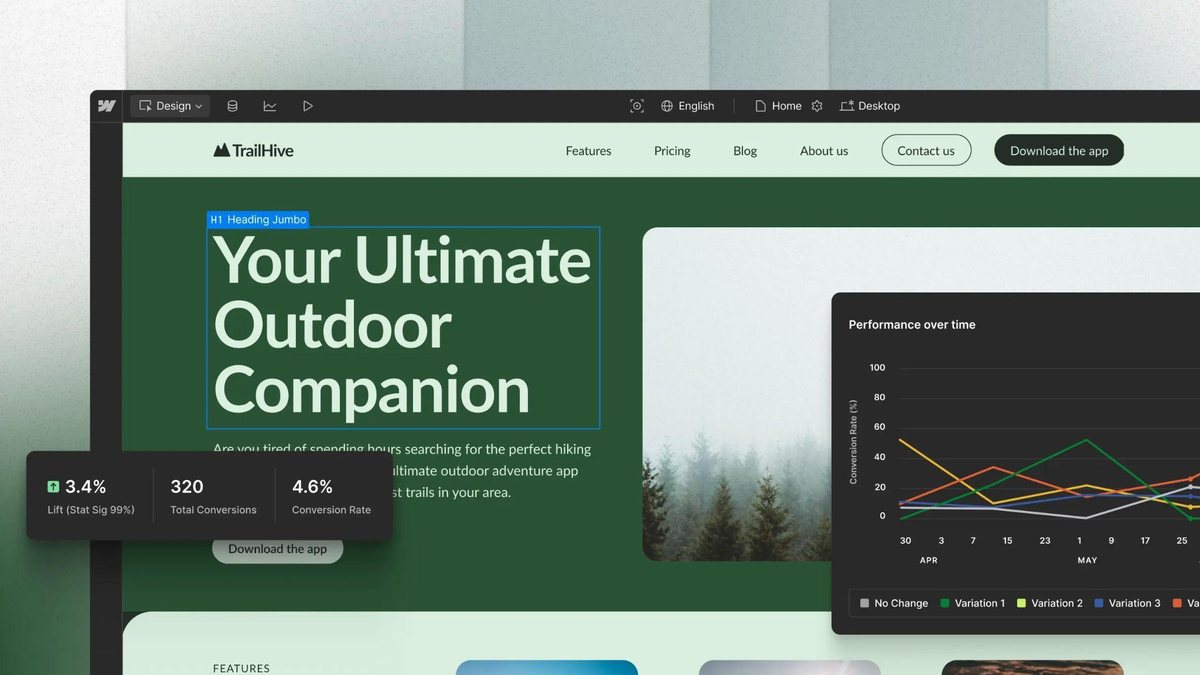
Native A/B testing, rules-based personalisation, and AI-driven variant selection in a single product layer. Configure variants visually in the Designer. Define audience rules (firmographic, behavioural, locale). Let AI Optimize allocate traffic to the best-performing variant in real time. The feature originally launched with Webflow Enterprise as an add-on; the integration with the Designer is native. It is now available on any paid Webflow Site plan as an add-on.
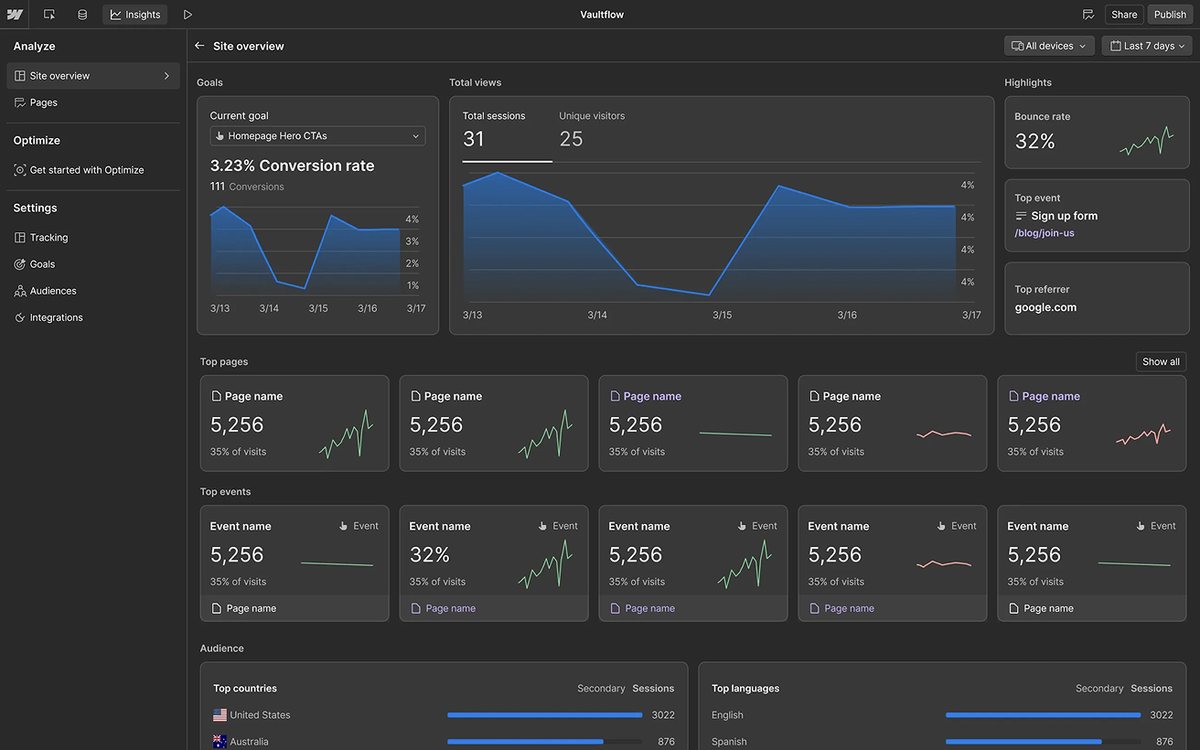
First-party analytics inside the platform: page views, sessions, click events, scroll depth, conversion goals, audience segmentation by device, language, location, and referrer. Includes click maps and scroll maps overlaid on the live design (without session recordings, keeping the privacy posture clean and the data volume low).
Optimize and Analyze cover the in-loop activity on the marketing surface. They do not replace the existing enterprise analytics stack; they integrate with it. Most DACH enterprise customers continue running Google Analytics 4, HubSpot, Salesforce Marketing Cloud, Segment, or Amplitude in parallel. Webflow Analyze is the product-team-level loop; the enterprise stack is the cross-functional loop. Both run simultaneously.
Integration with the existing marketing stack
The integration patterns that hold across the magier project portfolio:
GA4
Standard tag in the global custom code embed. Server-side GA4 via Google Tag Manager where the consent posture requires it.
HubSpot
Native form handler integration through the HubSpot Forms embed; deeper CRM integration through the HubSpot API, webhooks, and serverless functions, or via an external automation layer such as Zapier or Make for lead routing and enrichment.
Salesforce
Web-to-Lead form handler URL or Marketing Cloud Forms; deeper integration through the Webflow API v2 and a Salesforce REST API via a connected app.
Segment
Standard analytics.js embed; events fire from the Designer’s interactions or from custom code.
Amplitude
Standard tag; user-traits enrichment through the API where the workload requires it.
The pattern across all five: the marketing-stack tools sit where they sat before. Webflow replaces the website and the in-flight optimisation surface. It does not replace the customer data spine.
A Hypothetical DACH case, with illustrative numbers
A regulated industrial Mittelstand in NRW, composite illustration based on engagements magier has run. Figures are representative, not from a single client. This engagement profile covers replatforming from a TYPO3 estate to Webflow Enterprise across the corporate site and three product-line subsites, measured twelve months after launch.
- Tests run in the quarter (Q1 2026): 14 (versus 2 per quarter on the prior TYPO3 cadence).
- Tests reaching statistical significance: 9.
- Tests shipped as winners: 7.
- Conversion rate improvement on the contact-form path: +18.4%.
- Conversion rate improvement on the careers-application path: +11.2% (two examples drawn from the seven winning tests).
- Largest contentful paint, blended: 1.4 seconds (down from 3.1 seconds on TYPO3).
- Cumulative layout shift, blended: 0.04 (down from 0.18).
- Hours of developer-team time spent on the marketing-surface backlog: 92 (down from 720 in the prior twelve months).
The 628-hour reduction is roughly four FTE-months of senior developer time freed for product work, valued at approximately €60,000 to €80,000 at DACH labour rates. The conversion-rate improvements compound on top.
The cadence delta, in a single diagram
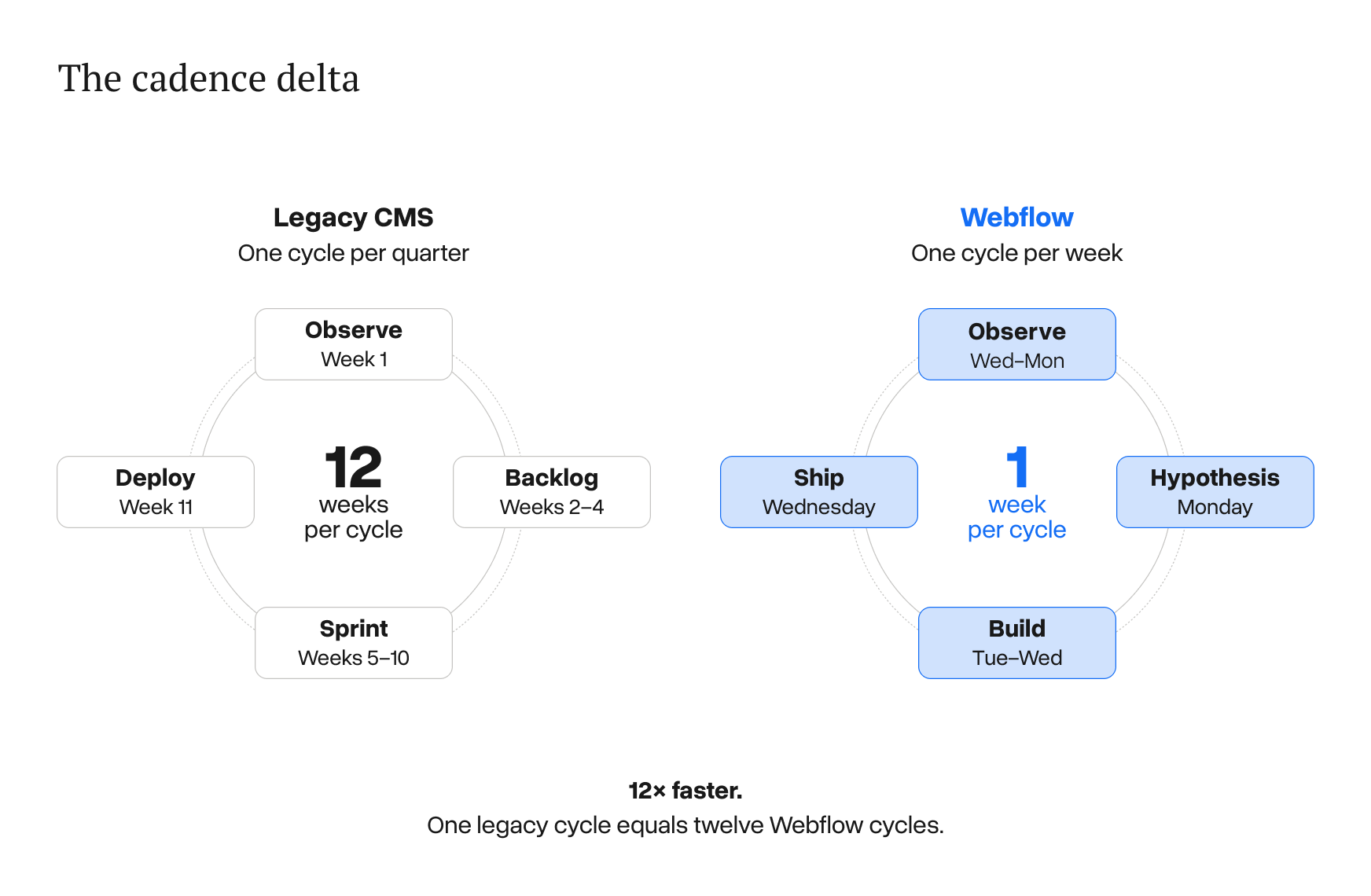
One cycle. 1 week.
Reader takeaway
From ‘Ship a website’ to ‘Run an optimisation engine that makes everything else get faster around’.
Moving to Webflow does not change how disciplined your team is. It means that discipline produces more output within the same time: more experiments, compounding week after week.
Section IIIThe Playbook
The first two sections of this book argued the case. Section II is named the operating model. Section III is the practical section. It outlines what a company should specifically consider if it is seriously evaluating Webflow as an option or is already preparing to make a decision.
There is no part of a Webflow rollout in this region that the rest of the world has run before. The compliance requirements drawn from Appendix A were from German, Swiss, and Austrian statutes, not US guidance. The internal stakeholder chain is longer here than in the UK or the Nordics. The 90 days that follow a ‘yes’ look different in Frankfurt, Zurich, and Vienna than they do in Austin or Amsterdam.
The four chapters that follow walk that ground in order. Chapter 10 is the diagnostic that the reader runs before deciding. Chapter 11 explains how the decision moves through nine internal stakeholders. Chapter 12 is the first 90 days, week by week, after the decision is made. Chapter 13 is about who runs the rollout, in-house or with a partner.
| Chapter 10 | Should You Switch to Webflow? |
| Chapter 11 | Getting Buy-In Internally |
| Chapter 12 | Your First 90 Days with Webflow |
| Chapter 13 | Choosing the Right Migration Partner |
Chapter 10.Should You Switch to Webflow?
This chapter tells you whether switching to Webflow makes sense for your specific situation, not whether it makes sense in general. Some enterprises should move their marketing surface to Webflow this year. Some should federate it with a platform they already have. Some should stay on what they run today. The diagnostic that separates the three runs consists of twenty questions, grouped into six clusters. The full version is in Appendix G. The compact version is below. The full worksheet is Appendix G.
We designed it to be worked through as a team, ideally in a single sitting, and to produce a clear go or no-go by the end.
How to use this diagnostic
Score each cluster green, amber, or red. Green means the cluster favors a Webflow move. Amber means there is friction that the rollout has to address but does not block. Red means a hard constraint that has to be solved before any platform decision is made.
The verdict at the end is the highest-friction cluster, not the average. One red can be enough to recommend a federated pattern instead of a full switch. Three reds usually point to staying on legacy until the underlying constraints change.
Cluster 1. DACH market context (5 questions)
- Where does the largest share of the website’s traffic come from? Germany, Austria, Switzerland, the wider EU, North America, or distributed?
- How many languages does the website serve today, and how many should it serve in 24 months? Count CMS Collections, not page-level translations.
- Is the company subject to NIS2, KRITIS, BFSG, or the EU AI Act high-risk obligations on the marketing surface itself, or only on adjacent systems? The marketing surface is rarely the regulated surface, but adjacent systems usually are. The Compliance at a glance section of Chapter 2 carries the full mapping.
- Does the marketing site share infrastructure or operational dependencies with a customer-facing transactional system?. If so, the transactional system likely sits inside the KRITIS or DORA scope. The federation pattern in the closing section of Chapter 8 applies.
- What is the current desktop search share split for the relevant DACH market? StatCounter data for Germany (May 2026) shows desktop at approximately 58% and mobile at 40%, with tablet at 2% — making Germany significantly more desktop-heavy than the global average (mobile 51%). If your site’s analytics show a materially different split, adjust the UX and Core Web Vitals priority accordingly.48Opportunity cost estimate against the booked media spend. The three-week airtime window carries €280,000 in spend. In this scenario the page is not live for roughly half of that window. The ~€45,000 figure assumes a conservative share of the media budget underperforms because traffic hits an outdated or missing landing page rather than the intended campaign experience. Modelled composite.
Green: traffic is concentrated in DACH, the marketing site is not a regulated surface, and search dependence is on Google.
Amber: traffic spans the EU and North America. Webflow serves global audiences without issue — the Amber here reflects increased content localisation and hreflang complexity, not a platform limitation.
Red: the marketing site itself is in the NIS2 or KRITIS scope. Note: Webflow’s clean semantic HTML output performs equally well across all major search engines (Google, Bing, Ecosia, Yandex) — this is not a platform constraint.
Cluster 2. Pain diagnosis (3 questions)
- How long does it take from a request to a published landing page that meets your design system standards? Measure in working days, end-to-end. The Forrester TEI of Webflow Enterprise study49Forrester, Total Economic Impact of Webflow Enterprisewebflow.com/resources/report/forrester-tei puts this at one week on Webflow against six weeks pre-Webflow on the sample studied.
- How much of the marketing team’s weekly capacity is spent waiting on engineering? The typical answer in DACH Mittelstand on legacy stacks is most of it.
- How many of the last ten campaign sites were launched on the planned date? If the answer is fewer than seven, the friction is structural, not operational.
Green: 14 days or fewer to a landing page, marketing waits on engineering for under 25% of weekly capacity, eight or more of the last ten campaigns launched on time.
Amber: 14 to 30 days, 25-50% wait time, six to seven on-time launches.
Red: more than 30 days, more than half of marketing capacity blocked on engineering, fewer than six on-time launches.
Cluster 3. Regulatory exposure (3 questions)
- Is BSI C5 a hard requirement on any current or planned RFP? Webflow does not hold a C5 attestation as of April 2026. The federation pattern in Appendix B names TYPO3 on German-sovereign hosting as the answer for that surface.
- Does the company process special categories of personal data through the marketing site, including newsletter or event registration data? The DSGVO Article 9 categories raise the AVV and DPIA bar.
- Is the company in scope of the KRITIS-Dachgesetz, which builds on the sector and threshold definitions in the BSI-KritisV, or of DORA? The marketing site is rarely the regulated facility, but the wider digital estate often is.
Green: No BSI C5 hard requirement, no special-category processing through the marketing site, no KRITIS or DORA exposure.
Amber: Any one of the three is partially in play.
Red: BSI C5 is a hard contractual requirement, or the marketing site itself is treated as a critical facility.
Cluster 4. Competitive reality (3 questions)
- Which platforms are on the current shortlist alongside Webflow? The typical list usually contains AEM, SitecoreAI, FirstSpirit, TYPO3, Storyblok, Contentful, and WordPress VIP, in some combination. Chapter 8 maps where each wins.
- What does the buyer actually want from this decision? Speed, control, AEO readiness, accessibility, regulatory cover, lower TCO, partner-network depth. Rank the top three.
- Is the incumbent platform a sunk cost in skills and process, or a live licence with renewal in the next 18 months? The answer changes the migration window.
Green: The top three priorities are speed, AEO readiness, and lower TCO, with a renewal window inside 18 months.
Amber: Split priorities, renewal window beyond 18 months.
Red: The top priority is something Webflow does not lead on (DAX-40 personalisation, sovereign hosting, on-premise multi-brand federation).
Cluster 5. Operating model (3 questions)
- Is the marketing team’s current operating model centralised or federated across business units? The Webflow Workspace model assumes federated authoring with central design governance.
- Does the company already run a Brand OS, defined for this question as a single source of truth for brand, content, and component reuse across surfaces?
- Is there an internal capability for a designer to work directly in the platform, or does every change route through engineering? Webflow flips that equation. Some teams are not ready for that change.
Green: Federated authoring, a Brand OS already in place or planned, a design team ready to ship without engineering as a gatekeeper.
Amber: Any one of the three is missing but addressable inside the rollout.
Red: A centralised marketing team without design capacity to ship, with no Brand OS and no plan to build one.
Cluster 6. Strategic stance (4 questions)
- Does the company treat the website as a revenue engine that the rest of the funnel depends on, or as a publishing channel? Chapter 1 puts a number on the difference; Chapter 9 covers what it means in practice. If the site sits in a cost-centre mental model, the platform change will be evaluated on licence.
- Is the organisation prepared to move publishing rights to the marketing team, with IT setting guardrails instead of operating the queue? This is the structural question behind every other one. A company that migrates to Webflow but keeps developer sign-off on every page has bought a faster ticket queue, not a different operating model.
- Is there an executive sponsor committed to changing the operating model rather than just the platform: who reviews, what gates remain, who owns time-to-publish as a metric? If nobody owns time-to-publish after launch, the eleven-week cascade returns within a year, with better tooling underneath it.
- Is the procurement organisation comfortable with a US-headquartered SaaS vendor with EU SCCs and DPF coverage, but without EU-only data residency until Webflow’s 2026 EU hosting roadmap50Webflow Trust Centertrust.webflow.com lands?
Green: The site is treated as a revenue engine, moving publishing rights to marketing is on the table with IT, and a named executive will own time-to-publish as a metric after launch.
Amber: The ambition is there but unowned. Publish rights are “to be discussed”, the sponsor is supportive but unnamed, and nobody has committed to owning the metric.
Red: The site is a cost centre, developer sign-off on every page is non-negotiable, and the expectation is that the existing process will be used on a new platform.
The four verdicts
A team that finishes the diagnostic falls into one of four shapes.
Full switch candidate
Five greens and one amber, with no reds. The marketing surface is the right scope, the operating model is ready, and the regulatory profile is clear.
Federated switch candidate
Three or four greens, with one or two reds in cluster 3 or cluster 4. Webflow runs the marketing and AEO surface. Another platform runs the regulated or specialist surface. The closing section of Chapter 8 sets out the federation pattern.
Partial switch candidate
Two or three greens, with reds clustered in the operating model or strategic stance. The platform decision is not the binding constraint. The team needs a Brand OS, a designer-led authoring discipline, or a steering committee willing to commit to the cadence. Solve those, then revisit the diagnostic in two quarters.
Stay on legacy
Three or more reds, or a single red in a category that cannot be solved inside 12 months. The answer here is to keep the incumbent platform, address the underlying constraint, and revisit.
Four DACH archetypes
These four archetypes are illustrative composites drawn from engagements magier has walked through. Specific revenue bands, regulatory scopes, and outcome figures are representative ranges; no single client is identified.
Full switch
A Mittelstand industrial automation company in south-west Germany, revenue in the €400m–€800m range, marketing site on a 12-year-old TYPO3 estate, six languages, no special-category data on the site itself. Twelve-week rollout. Engineering wait time on landing pages reduced from six weeks to under four working days (better than the Forrester one-week benchmark on a different, larger sample).
Federated switch
A Swiss private bank supervised by FINMA under Circular 2023/1 on operational risks and resilience, with DORA exposure arising only indirectly, via EU subsidiaries in scope or contractual flow-down where the bank provides ICT services to EU financial entities. The marketing surface moved to Webflow inside the federation pattern; the customer portal and authenticated services stayed on the existing governed stack. The boundary is clean by design: login routes from the marketing surface to the portal’s identity provider, and no customer credentials or session data touch the marketing stack. Design tokens are shared via the Brand OS, and the marketing surface runs GA4 with Consent Mode v2; portal analytics stay inside the governed stack.
Partial switch
A German industrial holding in Nordrhein-Westfalen, with six business units, has no shared design system. Every campaign request is routed through a central web team. The diagnostic returned amber across the operating model and strategic stance. The recommendation was to build the Brand OS first, on the existing platform, then revisit the platform decision in two quarters. They are now in a federated switch, started a year later than the original ambition.
Stay on legacy
A federal-state-linked German utility, a KRITIS operator classified as a particularly important entity under the German NIS2 implementation, with BSI C5 attestation treated by procurement as a hard contractual requirement even for the public-facing site. The diagnostic returned red on cluster 3: Webflow carries no C5 attestation as of April 2026. We recommended TYPO3 on German sovereign hosting and a structured-data plus accessibility programme on the existing platform, with a federated path held open should Webflow’s compliance surface change.
What to do with the result
The diagnostic produces a verdict, guiding to the next read. Full switch goes to Chapter 12. The federated switch goes to the closing section of Chapter 8 and Appendix B for the platform-by-platform verdicts. Partial switch goes back to the operating-model work from earlier. Staying on legacy is the honest answer, and the book does not press past it.
For everyone else, Chapter 11 is next. Whatever the verdict above, the decision still has to clear nine internal stakeholders. That is what the next chapter is for.
Chapter 11.Getting Buy-In Internally
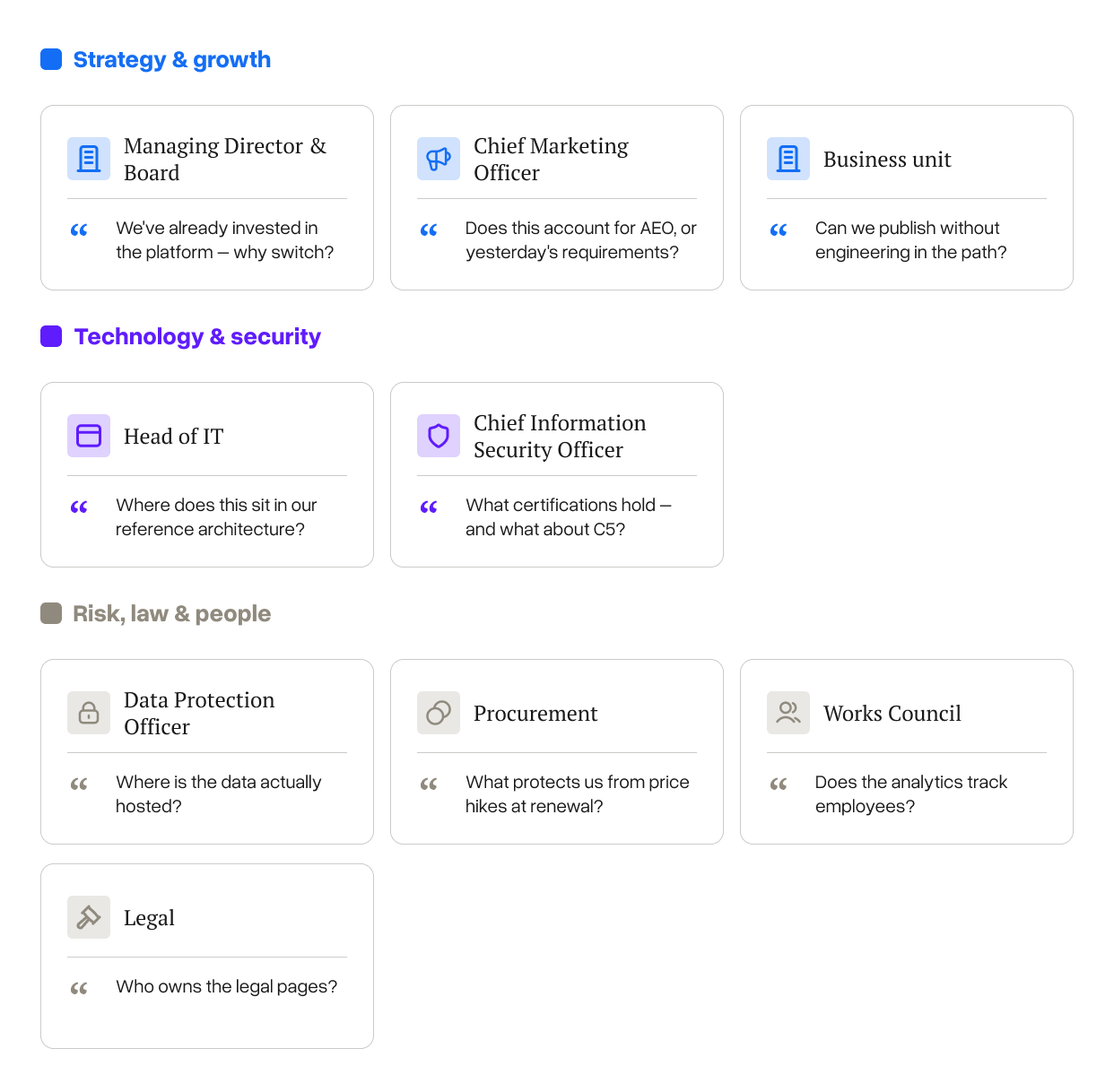
Internal buy-in is what determines whether a Webflow rollout succeeds, not the platform itself. The chain of stakeholders is where projects stall: the Managing Director or Board, the Chief Marketing Officer, the Head of IT, the Chief Information Security Officer, the Data Protection Officer, Procurement, the Works Council, Legal, and the business unit. Nine stakeholders, each with a different question, a different document on their desk, and the ability to block the decision if their question goes unanswered.
This chapter is the objection-handling playbook for that chain. Each stakeholder panel, it covers what they care about, the three objections you are likely to hear, and how to respond. The structure repeats for each panel.
Managing Director and Board
What they care about: time to market, strategic risk, brand-level consistency, and the total cost of the next three years.
The three objections:
-
We have already invested in the current platform. Why throw that away?
Response: The existing investment is a sunk cost. The forward decision is whether the marketing surface continues to constrain the rest of the funnel. The Forrester TEI study — modelled on a composite organisation of ~$2bn revenue derived from five interviewed customers — shows a 332% three-year ROI and under-six-month payback. The full TCO model in Chapter 6 puts the Mittelstand savings at €499,640 over three years.
-
Does this have a measurable impact for us, or is it a tooling preference the board should not be spending time on?
Response: A faster marketing surface ships more revenue per quarter from the same team. Pages are live when the media behind them runs, and the team ships more launches and tests because the ticket queue between idea and live page is gone. Speed pays twice: in media, you stop losing, and in the pipeline, you start shipping. If the website is not a meaningful revenue channel for you, this is not a board topic; for everyone else, Chapter 1 shows how to price it with your own numbers in one afternoon.
-
What does this look like in 12 months?
Response: The answer is in the Forrester sample and in the anonymised archetype examples in Chapter 10. The Mittelstand industrial customer cited there moved its marketing surface end to end in 12 weeks and held the cadence for 12 months on a measured basis.
Chief Marketing Officer
What they care about: execution speed against the campaign calendar, brand control across business units, accessibility cover under the BFSG, AEO readiness before the Google AI Overview share grows further.
The three objections:
-
A migration puts the organic traffic and lead pipeline I am measured on at risk.
This is the most legitimate concern on this list, and it is a process risk, not a platform risk. The 301 redirect table, the hreflang matrix, and the staged cutover in Chapter 12 exist precisely for this. The benchmark for a clean migration is roughly 90 percent of organic traffic recovered by day 30, measured against a KPI baseline captured before launch. If a partner cannot explain their redirect and traffic-protection plan in the first conversation, that is the wrong partner.
-
If everyone in marketing can publish, brand consistency and quality will slip.
Speed without guardrails spreads inconsistency faster. That is why the design system comes first in the rollout, not the publishing rights. Teams work inside locked components, tokens, and templates; the brand book governs identity, and the Brand OS turns it into something a designer can actually ship from. Editors change content, not the system.
-
We are choosing a platform just as AI search changes how buyers find us. Does this plan actually account for AEO, or are we migrating into yesterday’s requirements?
Response: It is built in, not bolted on. Chapter 7 defines the seven layers of the Webflow AEO stack and the technical foundation, semantic HTML, structured data, the robots.txt policy, and the llms.txt, ships inside the migration in Weeks 9 to 10, largely as a by-product of how the platform publishes. The Day-30 review in Chapter 12 captures your first AI-citation baseline, and content authority builds over the following two quarters. The honest limitation is stated openly: nobody has a mature AEO attribution model yet. That is precisely why the groundwork belongs inside the migration now, not in a retrofit project two years from now.
Head of IT
What they care about: architecture fit, identity and SSO integration, the exit path on day one of year four if the platform decision turns out to be wrong.
The three objections:
-
Where does this sit in our reference architecture?
Response: The marketing surface is decoupled from the regulated surface. Webflow runs the presentation and the optimisation loop. The CMS, DAM, identity, and analytics integrate via the Webflow API v251Webflow Data API referencedevelopers.webflow.com/data/reference/rest-introduction and DevLink for components. Chapter 5 mapped the engineering surface in full.
-
Does it support our SSO?
Response: SAML SSO is on Enterprise plans, [as documented in Webflow help52Webflow Help Center, Single sign-on (SSO) with SAMLhelp.webflow.com/hc/en-us/articles/24811801580819-Single-sign-on-SSO-with-SAML. Sites and Workspaces sign-in works against the company’s identity provider. SCIM provisioning is supported.
-
What is the exit path?
Response: The Webflow site exports as a static HTML and CSS package. CMS Collections export to CSV. Custom code blocks are inspectable. The exit path is documented and runs in days, not quarters.
Chief Information Security Officer
What they care about: ISO 27001 and SOC 2 cover, NIS2 supply-chain governance, incident response timelines, the C5 gap.
The three objections:
-
What certifications does Webflow hold?
Response: ISO 27001:2022, ISO 27017:2015, ISO 27018:2019, ISO 42001:2023, SOC 2 Type II, SOC 1 Type II53Webflow Trust Centertrust.webflow.com, with PCI DSS via Stripe. DORA and DSA considerations are addressed within the Trust Center documentation.
-
We are an essential entity under the NIS2 Implementation Act54NIS2 implementation in Germanyopenkritis.de/eu/eu-nis-2-germany.html. Does this work for our supply-chain governance?
Response: Yes, with three caveats. The vendor supports NIS2 supply-chain due diligence with the Trust Center artefacts. The 24-hour, 72-hour, and one-month incident-reporting timelines under NIS2 Article 23(4)55Directive (EU) 2022/2555 (NIS2)eur-lex.europa.eu/eli/dir/2022/2555/oj are tested in the cutover runbook in Chapter 12 Week 11. BSI C5 is the explicit gap.
-
What does the BSI C5 gap mean in practice?
Response: It means RFPs that hard-require C5 attestation as a contractual gate (most public sector tenders, some regulated industries) currently exclude Webflow. For those surfaces, the federation pattern set out in the closing section of Chapter 8 routes the work to TYPO3 on German-sovereign hosting. For the marketing surface in commercial contexts where C5 is not contractually required, the existing certification stack is materially complete.
Data Protection Officer
What they care about: the AVV, TOMs, third-country transfer cover, DPIA outcome, data subject rights workflow.
The three objections:
-
We need an Auftragsverarbeitungsvertrag (AVV, the data processing agreement under Article 28 GDPR with Article 28 cover)56GDPR Article 28gdpr-info.eu/art-28-gdpr.
Response: pre-executed AVV with EU SCCs Modules 1, 2, and 3, available through the Webflow Trust Center. The AVV request pattern is in Appendix D and reproduced in German on the Trust Center.
-
What about a Datenschutzfolgenabschätzung (DPIA)?
Response: A DPIA is required for high-risk processing under DSGVO Article 35. The marketing site’s DPIA template is in Appendix D. The risk profile is materially lower than the regulated surface, but the DPIA still runs.
-
Where is the data hosted?
Response: On Webflow’s US-headquartered infrastructure, with EU SCCs and DPF cover. EU residency is on the Webflow roadmap for 2026 with no public date. For the surfaces where EU-only residency is a hard requirement today, the federation pattern routes the work elsewhere.
Procurement
What they care about: the Rahmenvertrag (framework agreement), price protection at renewal, exit terms, and the Gerichtsstand (jurisdiction).
The three objections:
-
What protects us against price increases at renewal?
Response: This is where SaaS procurement wins or loses the three-year TCO, and it belongs in the framework agreement, not in a side letter. Negotiate a cap on annual increases (CPI-linked or a fixed percentage), lock the discount structure for the initial term plus one renewal, and tie any usage-based components to defined metrics. The TCO model in Chapter 6 assumes contractually capped pricing; without that clause, the model’s third year is a hope, not a number.
-
What happens at termination: what do we get out, in what format, and who helps?
Response: content exports via CSV and the API; the design itself exports as code, though it is built to run on Webflow, and a migration is a re-implementation, not a copy. Negotiate three things into the agreement before signature: a defined post-termination export window (90 days is achievable), no deletion before written confirmation, and read-only access during the window. The honest framing: the content is fully portable, the design layer is partially portable, and that trade is the same on every platform in Chapter 2, including the incumbent.
-
Where is the Gerichtsstand?
Response: The default is California law and venue, and below very large contract volumes, it will stay that way; Webflow contracts through its US entity, and US SaaS vendors rarely concede governing law. Procurement’s energy is better spent on the protections that work without ever going to court: remedies and service credits written into the agreement itself, the termination and export rights from objection 2, and the data-protection layer, where the AVV and SCCs follow European law regardless of what the master agreement says. Raise German venue, accept the no, and trade it for one of these.
Quick answers for the checklist items. The Haftungsobergrenze is twelve months of subscription fees, the SaaS industry standard, and at typical contract volumes, it will not move; the exposure on a marketing surface is bounded, and the data-protection layer is governed by the AVV regardless of the cap. Ask, document, move on. Where procurement policy requires Schriftform on amendments, the Enterprise process accommodates it; the AVV itself needs only written form, including electronic form under GDPR Article 28(9).
Works Council
What they care about: § 87 Abs. 1 Nr. 6 BetrVG57§ 87 BetrVGgesetze-im-internet.de/betrvg/__87.html co-determination on technical devices intended to monitor employee behaviour or performance, the Betriebsvereinbarung that follows, the Schriftform on its execution.
The three objections:
-
Webflow Analyze tracks visitor behaviour. Does that include employees?
Response: visitor analytics on a public marketing site sits outside the BetrVG scope when employees are not the data subjects. Webflow Analyze on internal-facing surfaces, or on authenticated employee portals, is in scope and triggers § 87 Abs. 1 Nr. 6 co-determination. The line is whether the technology is bestimmt (intended) to monitor employee behaviour or performance.
-
We need a Betriebsvereinbarung before launch.
Response: The Betriebsvereinbarung covers the analytics setup, the optimisation programme, and the training pathway. Template in Appendix D. Cutover runbook in Chapter 12, Week 11 confirms execution.
-
Who runs the training?
Response: Training pathways for designers, marketers, and content authors are part of the Works Council agreement. The Webflow University course library is in scope. The certification path runs alongside.
Legal and the business unit (combined panel)
What Legal cares about: the Impressum and Datenschutzerklärung copy, copyright on imported assets under the UrhG58Urheberrechtsgesetz (UrhG)gesetze-im-internet.de/urhg, the cookie banner under § 25 TDDDG59§ 25 TDDDGgesetze-im-internet.de/tdddg/__25.html. What the business unit cares about: their roadmap, their team’s authoring time, their analytics access.
The three combined objections:
-
Who owns the legal pages?
Response: The Rechts-Seiten ship in Week 11 of the rollout as reusable Components. Legal owns content. Marketing owns the design system instance. The cookie banner integrates with a CMP that the Data Protection Officer signs off on.
-
Can our business unit author without engineering on the path?
Response: yes. That is the operating-model shift in Chapter 5. The Shared Libraries and CMS Collections are designed for federated authoring with central design governance. The training pathway carries a designated authoring role per business unit.
-
Where does our analytics live?
Response: Webflow Analyze for product-surface analytics, GA4 with Consent Mode v2 for cross-platform analytics, and a Brand OS dashboard pulling from both. Each business unit gets its own view.
If the case is made and the decision is yours to execute, Chapter 12 is the first 90 days.
Chapter 12.Your First 90 Days with Webflow
The 90-day plan in this chapter assumes the organisation has decided to move to Webflow and includes a practical implementation plan. The timeline and workload here are scoped for a migration: moving an existing site to Webflow with structural and content parity as the goal. If the project also involves a redesign — new information architecture, visual identity work, or a significant content overhaul — the scope and timeline will be materially different. A redesign-plus-migration is a separate engagement and should be planned accordingly; the 90-day model below does not cover it.
A DACH Webflow rollout is governed week by week, not sprint by sprint. The compliance gates, the stakeholder sign-offs, and the legal artefacts that DACH enterprises carry make the cadence here different from a US or UK rollout. The week-by-week plan below is what we run on most of our clients’ rollouts that ship on time. In addition to that, the 20 most common failure modes are listed at the end of the chapter.
The 12-week plan at a glance
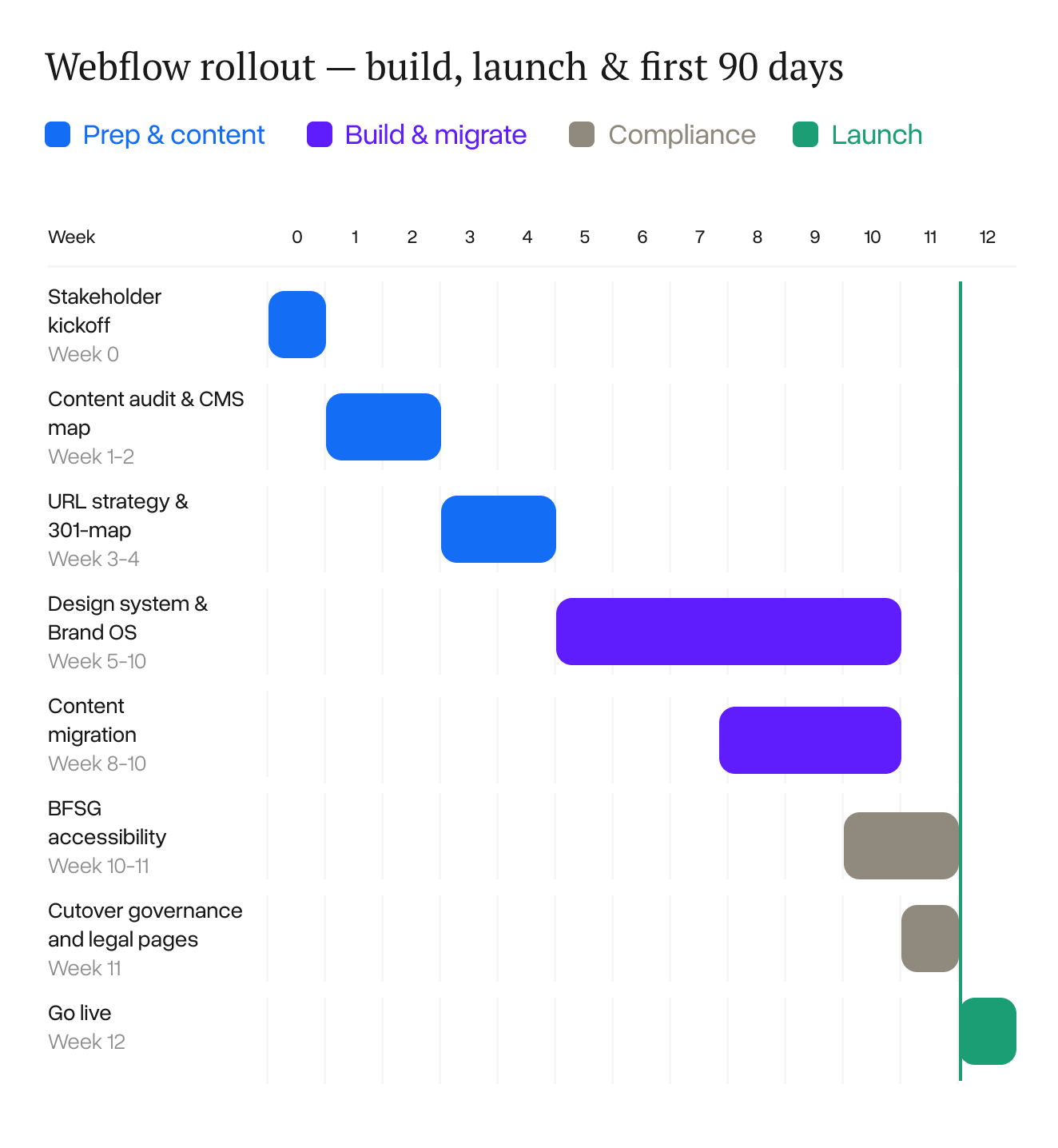
The table below is the steering committee version of the rollout. Every gate is a hard pass-fail.
| Week | Workstream | Hard gate |
|---|---|---|
| 0 | Stakeholder kickoff | AVV requested. § 90 BetrVG notification sent. |
| 1 to 2 | Content audit and Redaktionssystem mapping | Sunset list and CMS Collection model signed off. |
| 3 to 4 | URL strategy, 301-map, hreflang | 301-map and hreflang matrix signed off. |
| 5 to 10 | Design system and Brand OS build (runs weeks 5–10) | AEO schema templates live. |
| 8 to 10 | Content migration into Webflow | All priority pages live in Webflow CMS; content parity sign-off by Programme Lead |
| 10 to 11 | BFSG remediation | WCAG 2.1 AA audit cleared, Erklärung zur Barrierefreiheit drafted. |
| 11 | Cutover governance and legal pages | DSFA updated; NIS2 register amended (if in scope); 301 stress test passed; Legal sign-off on Impressum, privacy policy, AGB, and cookie banner. |
| 12 | Launch and 30-60-90 cadence | Tuesday launch, Day 1, Day 7, Day 30, Day 60, Day 90 reviews on the calendar. |
Week 0. Stakeholder kickoff
The kickoff covers four agenda items. The signed-off scope (single business unit, federated rollout, or full enterprise). The named owners across the stakeholder panels are in Chapter 10. The AVV request was submitted to Webflow’s Trust Center. The Works Council is informed in writing in good time under § 90 BetrVG as the Webflow rollout is planned, and, where the platform or its analytics are objectively capable of monitoring employee behaviour or performance, is involved under the co-determination right in § 87(1) No. 6 BetrVG.
By the end of Week 0, the project has a steering committee, a single accountable Programme Lead, a Data Protection Officer named on the project, and a Works Council representative who has the timeline.
Weeks 1 to 2. Content audit and Redaktionssystem mapping
The content audit answers two questions: what is on the current site, and what is worth keeping. Most legacy DACH systems carry between 30% and 60% redaktionellen Ballast, content that has not been touched in over 24 months and produces no measurable engagement. The cutover is the moment to remove it, not the year after.
The Redaktionssystem mapping translates the current authoring model into Webflow CMS Collections, Components, and Shared Libraries. The patterns we have seen work cleanly:
| From | To |
|---|---|
| TYPO3 tt_content records | Webflow CMS Collection items + reusable Components |
| AEM Components and Templates | Webflow Components, Shared Libraries for federation |
| WordPress Gutenberg blocks | Webflow Components for global blocks |
| FirstSpirit Templates | Webflow Components and CMS Collections |
| Sitecore Renderings | Webflow Components, with structured data preserved |
Each row is a category, not a one-to-one map. The mapping is owned by the design system lead, reviewed by the IT architect, and signed off by the programme Lead. The test of the mapping is whether a content author from the legacy systems can recreate a representative page in the new model in under thirty minutes, with no engineer in the room. If the answer is no, the model is wrong, not the author.
Weeks 3 to 4. URL strategy, redirects, and hreflang preservation
DACH organic traffic does not survive a careless cutover. The 301-map is the single most underestimated artefact in the rollout. The map covers every URL that has measurable traffic in the last 12 months, every URL with backlinks that Google Search Console reports as referring, and every locale variant.
Hreflang preservation is the second underestimated artefact. The locale matrix has to map cleanly from the legacy structure to Webflow’s native localisation, which generates locale-specific URLs and hreflang tags at the time of the cutover. Bing and Ecosia recover more slowly than Google. Plan accordingly.
By the end of Week 4, the 301-map exists, the hreflang matrix exists, and the URL strategy is locked and ready. The stress test — covering the top 200 URLs by impressions in Search Console, the top 50 URLs by referring backlinks, and a sampled 100 long-tail URLs — runs later, once all content is live in Webflow CMS and the full build is complete. A 301-map that survives that test set survives launch.
Weeks 7 to 8. BFSG remediation gate
Week 7 runs the conformance audit and remediation backlog triage. Week 8 is the remediation gate: either the audit signs off on launch readiness, or the launch moves by one week.
The BFSG conformance audit runs against WCAG 2.1 AA, as the Bundesfachstelle Barrierefreiheit guidance confirms. The audit covers automated checks (Lighthouse, axe-core), manual screen-reader walkthroughs in NVDA and VoiceOver, keyboard-only navigation tests, and colour-contrast verification across the design system.
The Erklärung zur Barrierefreiheit (accessibility statement) is drafted in this window, signed off by Legal, and ready to be published at launch. § 14 1 Nr. 2 BFSG in conjunction with Anlage 3 Nr. 1 sets the requirement. The statement covers the conformance state, the responsible person, the contact for complaints, and the schedule for revisions.
The remediation gate at Week 8 either signs off the audit or pushes the launch by one week. There is no compressing this. The accessibility programme also continues post-launch as a quarterly cadence, not a one-time audit. The BFSG enforcement window opened on 28 June 2025, and complaints under §§ 32, 33, 34 BFSG carry a documented process that the conformance statement has to point to. The audit is a minimum requirement, not the end of the accessibility work.
Weeks 5 to 10. Design system and Brand OS build (runs weeks 5–10)
Weeks 5 to 6 establish the foundation: semantic design tokens, the initial component library, and the first structured CMS schemas. Weeks 7 to 8 expand and harden the system: Shared Libraries are federated, AEO copy patterns are reviewed against the Brand OS, and structured-data templates are locked for production use.
The design system and the Brand OS land here with concrete deliverables. Semantic design tokens (colour, typography, spacing) shipped through Webflow’s Variables feature. Component library built and federated through Shared Libraries. AEO copy patterns reviewed against the Brand OS. Structured-data templates are loaded into the CMS Collection schemas. The shared Webflow Libraries marketplace listing for any partner-shared component library, where applicable.
By the end of Week 10, the design system is the source of truth. The federation pattern is also locked here. If the rollout is a federated switch (Chapter 10’s second archetype), Shared Libraries are available across all sites within the single Workspace — federation is a one-Workspace, multiple-sites model, not separate Workspaces per business unit. The design lead locks the tokens and component structure; each business unit authors content within those constraints on its own site.
Week 11. Cutover governance and legal pages
Week 11 is the final preparation for the launch, and it runs on two tracks.
The first track is governance. The Datenschutz-Folgenabschätzung (DSFA) is refreshed with the cutover-day processing flows. For NIS2 in-scope entities, Webflow enters the ICT supplier register, and the reporting path is tested once against the Article 23(4) timelines: 24-hour early warning, 72-hour notification, one-month final report, CSIRT contact confirmed. Out-of-scope organisations skip this step. Procurement signs the final amendment, under Schriftform, where the framework agreement requires it. The Works Council confirms the Betriebsvereinbarung is in force; where co-determination applies, that negotiation started in Week 0 because it is the longest lead item in the plan. The 301-map stress test, covering the top 200 URLs by impressions, the top 50 by referring backlinks, and a sampled 100 long-tail URLs, also runs now, once all content is live in Webflow CMS and the full build is complete.
The second track is the legal layer. The legal pages launch as reusable Components, owned by Legal and deployed across every locale: the Impressum (statutory imprint under § 5 DDG), the Datenschutzerklärung (privacy policy under DSGVO Articles 13 and 14), the AGB where commerce sits on the marketing surface, and the cookie banner integrated with the consent management platform. The CMP connects to Webflow’s consent-management APIs for Analyze and Optimize and to GA4 Consent Mode v2, so tracking reflects the visitor’s consent state automatically. Components update once and propagate: change the Datenschutzerklärung once, and every locale carries the new version. Webflow’s version control records each Component change with a named author and a timestamp, so the full history of every legal text, who changed which clause, when, and what was live on any given date, exists as a record rather than in anyone’s memory. When a regulator asks, the history is already documented.
If any of these gates fail, the launch moves by a week.
Week 12. Launch and the 30-60-90 cadence
The launch ships on a Tuesday morning, never on a Monday. The post-launch monitoring follows a 30-60-90 rhythm.
- Day 1: site availability monitoring, 301-map verification on a sample of 200 high-traffic URLs, hreflang sample check, Search Console submission.
- Day 7: Structured-data coverage check, AEO crawler access logs, accessibility regression check.
- Day 30: organic traffic recovery report (90% recovery is the usual target by this point on a clean migration), AEO citation tracking baseline, conversion-rate benchmark against pre-launch.
- Day 60: first Webflow Optimize tests live in production, weekly cadence locked in.
- Day 90: the first quarterly review of the operating model, the cadence-delta report from Chapter 9.
The site goes live at the start of Week 12. By Day 90, the cadence is in place, and the optimisation loop is the unit of work the organisation runs on.
The 20 most common rollout failure modes
- AVV is not signed before authentic data flows.
- Works Council was either not informed at all, because nobody knew § 90 BetrVG applies to a platform rollout, or informed in Week 8 instead of Week 0.
- Sign-offs were queueing with executives for two weeks; decision latency was the legacy disease, and it migrated.
- Scope creep: the migration becomes a redesign plus a rebrand.
- No pre-launch KPI baseline was captured, so the Day-30 recovery report has nothing to recover to.
- 301-map and hreflang matrix are incomplete on locale variants and return-tags.
- PDFs, whitepapers, and media files are not migrated or redirected; every link in old campaign emails and sales decks breaks on day one.
- The cookie banner is not Consent Mode v2 compliant.
- A locale override pins an old version: content updates in the primary locale, while a secondary locale silently keeps the previous wording.
- BFSG audit is deferred to post-launch.
- Erklärung zur Barrierefreiheit is not published at launch.
- Content and translations are late: the system ships, the words do not.
- Design system is shipped as a deck, not as Variables and Components.
- Designated authoring role per business unit is not trained.
- DSFA is not refreshed for cutover-day processing.
- NIS2 supplier register was not updated after the vendor change (in-scope entities).
- CRM and lead-routing integrations are left untested; forms fire into nothing on day one.
- DNS cutover with high TTLs and no rollback window.
- Search Console property is not verified before launch.
- The 30-60-90 cadence is not on anyone’s calendar.
Chapter 13.Choosing the Right Migration Partner
Enterprise Webflow migrations in DACH are rarely determined by the platform. The partner is usually the deciding variable. The platform is comparatively forgiving. The right partner turns a clean 90-day rollout into exactly that. The wrong one turns it into a six-month escalation that exhausts the steering committee.
This is the chapter on who runs the migration.
The Webflow Partner Program
The Webflow Partner Program is a four-tier ladder as of late April 2026 (the Foundations tier launched on 28 April 2026). The structure ranks every credentialed builder against a public scorecard, which makes it possible to evaluate a partner against a known frame.
| Tier | Position |
|---|---|
 | Entry-level credential, introduced on 28 April 202660Webflow Foundations Partner announcementwebflow.com/blog/webflow-foundations for freelancers and small agencies starting. |
 | Established practices, with a reviewed portfolio and pre-qualification, are listed in the Certified Partner directory61Opportunity cost estimate against the booked media spend. The three-week airtime window carries €280,000 in spend. In this scenario the page is not live for roughly half of that window. The ~€45,000 figure assumes a conservative share of the media budget underperforms because traffic hits an outdated or missing landing page rather than the intended campaign experience. Modelled composite.. |
 | High-volume, high-quality agencies with sustained complex project delivery. |
 | A badge layered on Certified or Premium status, confirming Enterprise plan delivery experience62Introducing Webflow’s Certified Partner Programwebflow.com/blog/introducing-webflows-certified-partner-program. |
A Premium Partner with the Enterprise distinction is the highest-credentialed partner that an enterprise buyer can engage. There are roughly 1,000 Certified Partners worldwide as of 2026. The number of Premium Partners with Enterprise distinction in DACH is currently 2 (based on the partner directory as of June 2026).
It’s worth noting that the badge confirms a baseline, but it does not confirm DACH-specific operational capability. That is the second filter.
Why partners matter more in DACH than in the US
A US enterprise Webflow rollout has a procurement chain of about three signers, one privacy review, one accessibility check, and a single English-language QA pass. A DACH enterprise rollout carries the nine-stakeholder chain in Chapter 11, the BFSG audit gate, the AVV negotiation, and a multi-language QA across German, Austrian, and Swiss legal locales. Each of those is a point where an underprepared partner stalls.
The US-trained partner who has not run the BFSG gate before learns it on the customer’s calendar. The customer cannot afford that. The DACH-native partner has that gate as a standing line item in every project plan. That is the difference. It compounds across nine stakeholders.
The other variable is language. The Datenschutzerklärung, the cookie banner, the Erklärung zur Barrierefreiheit, and the Betriebsvereinbarung are all reviewed, signed off on, and negotiated in German. A partner whose project team cannot work in German routes every legal artefact through translation, which is slow and often loses the legal nuance the original carries.
The 10-question partner evaluation rubric
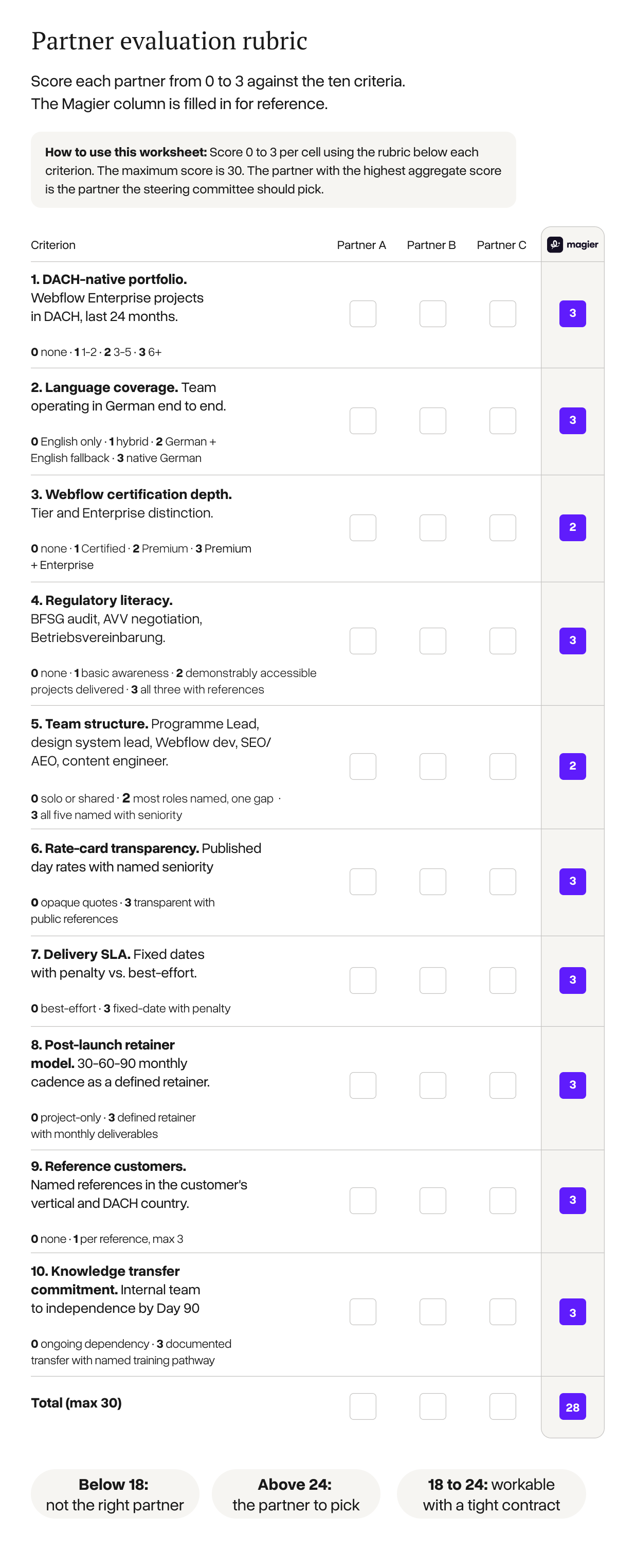
Run a shortlist of three partners through this rubric. Score each from 0 to 3. The partner with the highest aggregate score is the partner the steering committee should pick.
- DACH-native portfolio. How many Webflow Enterprise projects has the partner shipped in DACH in the last 24 months? Score 0 for none, 1 for one to two, 2 for three to five, 3 for six or more.
- Language coverage. Does the project team operate in German end-to-end? Score 0 for English only, 1 for hybrid, 2 for German with English fallback, 3 for native German across the project team.
- Webflow certification depth. Tier and Enterprise distinction. Score 0 for none, 1 for Certified, 2 for Premium, 3 for Premium with enterprise distinction.
- Regulatory literacy. Does the partner know the DACH compliance landscape well enough to plan around it? Two things matter. First, accessibility is built in, not audited afterwards: the partner ships WCAG-conform work as its default standard, because BFSG conformance is the one compliance outcome the partner itself controls. Second, the partner can tell the customer in week zero which internal sign-offs the rollout will need and when (Legal, Data Protection Officer, works council where one exists), so no gate surprises the project later. Score 0 for no DACH regulatory awareness, 1 for awareness but no delivery evidence, 2 for shipped accessibility-conform work, 3 for both, with named customer references.
- Team structure. Does the project team carry a programme Lead, a design system lead, a Webflow developer, an SEO and AEO specialist, and a content engineer? Score 0 for solo or shared roles only, 3 for all five named with seniority.
- Rate-card transparency. Does the partner publish blended day rates with named seniority levels, or work behind opaque project quotes? Score 0 for opaque, 3 for transparent with public references.
- Delivery SLA. Does the partner sign delivery dates with penalty clauses, or work on time and materials with best-effort delivery? Score 0 for best-effort, 3 for fixed-date with penalty.
- Post-launch retainer model. Does the partner offer the 30-60-90 monthly cadence from Chapter 12 as a defined retainer, or only project-based engagements? Score 0 for project-only, 3 for defined retainer with monthly deliverables.
- Reference customers in the relevant DACH market and segment. Does the partner have at least three named references in the customer’s industry vertical and in the DACH country? Score 0 for none, 1 for each reference, to a max score of 3.
- Knowledge transfer commitment. Does the partner bring the customer’s internal team to operational independence by Day 90, or retain ownership of the platform beyond that? Score 0 for ongoing dependency, 3 for documented transfer with named training pathway.
The maximum score is 30. A partner under 18 is not the right partner. A partner between 18 and 24 is workable with a tight contract. A partner over 24 is the partner to pick.
Noteworthy red flags
- A ‘Webflow Partner’ that cannot be found in the official partner programme.
- A portfolio without DACH customers in the last 24 months.
- A team that does not carry a Programme Lead distinct from the project’s senior designer.
- A reference customer who cannot be reached, or whose project shipped over a year ago and is no longer maintained.
When to run without a partner
Some rollouts do not need a partner, but the list is short: a single-language marketing site, under 200 pages, with no special-category data and an in-house design and Webflow Developer team that has shipped at least one Webflow site of comparable complexity. That team can run the 90-day plan in Chapter 12 without external help.
Everything above that scope benefits from a partner.
How magier fits
magier is a Webflow Premium Partner with Enterprise project experience, built for the DACH rollout this book describes. The team is Berlin-based, operates entirely in German, and specialises in Webflow Enterprise migrations for growth companies and Mittelstand organisations. The work spans UI/UX, brand, and the full Webflow build, with complex migrations as a core competence rather than an occasional project.
Scored against the ten-question rubric in this chapter, magier rates high on DACH-native delivery (criterion 1), native German operations (criterion 2), and post-launch retainer model (criterion 8). On platform breadth (criterion 3), the certification is Webflow Premium without the Enterprise distinction badge: the Enterprise project experience is in place, the formal badge is not yet held. On team structure (criterion 5), the pod model covers the program lead, design-system lead, and Webflow developer; AEO and SEO specialisation are brought in on a per-project basis.
The rubric on the previous pages was written so that a DACH steering committee can run it on any partner, including magier. Run it. The honest score matters more than the comfortable pitch.
When magier is not the right partner: if the rollout is the exception case described earlier in this chapter (one language, under 200 pages, no complex integrations, an in-house team that has shipped comparable Webflow work), an independent run of the Chapter 12 plan is entirely viable. And if the platform assessment in Chapter 8 and Appendix B points to a different platform as the right answer, magier will say so on the first call rather than migrate a team onto the wrong stack.
The first conversation is a scored read of the estate against the Chapter 10 diagnostic and this rubric. Not a pitch. The outcome is a clear view of whether Webflow is the right answer and whether magier is the right partner to run it.
| # | Criterion | magier | Why |
|---|---|---|---|
| 1 | DACH-native portfolio | 3 | Enpal, Kertos, Upvest, plancraft, and others |
| 2 | Language coverage | 3 | Berlin-built, German-native project teams. |
| 3 | Certification depth | 2 | Webflow Premium Partner (no enterprise distinction), but experience with Enterprise Projects |
| 4 | Regulatory literacy | 3 | WCAG-conform build is the delivery default, checked in the four-eyes review before every publication. DACH sign-off map (Legal, DPO, works council) is planned for week zero on every rollout. German-law entity with the majority of engagements for German and DACH enterprise teams, delivered in German. Named references available. |
| 5 | Team structure | 2 | A dedicated project manager coordinates a named pod: design-system lead, Webflow developer. No solo or shared roles. No AEO / SEO experts in-house. |
| 6 | Rate-card transparency | 3 | Plans and prices are published at magier.com/pricing: a Webflow entry tier, two full subscription tiers, and a combined design-and-Webflow tier, each monthly cancellable, with the out-of-scope hourly rate stated alongside them. Scoped one-time projects are quoted individually. |
| 7 | Delivery SLA | 3 | Committed launch timelines: weeks, not months. |
| 8 | Post-launch retainer | 3 | The 30/60/90 cadence in Chapter 12 is the delivery structure, not an optional extra. A defined monthly subscription with monthly deliverables, not a project that ends at launch. |
| 9 | Reference customers | 3 | Named references across verticals: fintech (Upvest), energy/proptech (Enpal), data privacy (Kertos), SaaS (plancraft) |
| 10 | Knowledge transfer | 3 | We build for your team to run the platform independently. Clean component architecture, documented training pathway. The subscription continues only as long as it earns its place; capacity you choose to keep, never lock in, you cannot leave. |
That self-score is the point: we hold ourselves to the same standard the rubric asks of any partner.
Afterword
In the foreword I described a pattern I have watched for most of my working life. A marketing team has no shortage of ideas. Every idea becomes a ticket, every ticket takes its place in a queue, and somewhere in that queue the good ones quietly expire. That was the picture this book set out to explain, and it is worth returning to now that you have the whole argument in front of you.
After more than a hundred Webflow projects across Germany, Austria and Switzerland, I would state the conclusion more plainly than I could have three years ago. The CMS was almost never the real constraint. The constraint was the handover. Whenever responsibility for a result sits with one team and the ability to produce that result sits with another, you pay for the distance between them in weeks, and you pay every single time. That is why the platform question matters at all. Not because one piece of software is inherently better than another, but because the platform quietly decides how many handovers an ordinary change requires. It is a smaller claim than the ones usually made for software, and it is the one that has held up on every project we have run.
Where this is heading
The readership of your website is changing, and that is the shift I would keep an eye on. For twenty years we wrote for people and made small concessions to crawlers along the way. Increasingly the first reader is a machine that reads, summarises and decides what to cite, and the person you actually care about meets your company through that summary rather than through your homepage.
I am not going to predict which assistants will matter in five years, because nobody sensibly can. The structural point is narrower and more durable. Companies that can publish quickly, structure their content legibly and correct themselves in public will be represented in those answers. Companies still waiting for the next release window will be described by someone else, or not described at all. Speed stopped being a matter of comfort some time ago. It compounds now, one experiment, one localised variant and one cited page at a time.
Thank you
This book came out of other people’s projects, including the ones that did not go smoothly, and we learned considerably more from those. My thanks to the teams who let us into their approval processes, their legacy systems and their internal politics, and to my co-authors, who spent months turning a long-running argument into something you could actually read.
Appendix
Appendix A: What Webflow Enterprise Offers: A Trust Center Summary
This appendix summarises what Webflow Enterprise delivers to the buyer’s compliance and security questions, drawn directly from the Webflow Trust Center in April 2026. It is not a legal opinion, and it does not replace one. Every line below should be verified live at trust.webflow.com before any contracting decision is made.
Certifications and attestations in place
All of the following are listed in its Trust Center:
- ISO/IEC 27001:2022: information security management system
- ISO/IEC 27017:2015: cloud-specific security controls
- ISO/IEC 27018:2019: protection of personally identifiable information in public cloud
- ISO/IEC 42001:2023: artificial intelligence management system
- SOC 2 Type II: security, availability, and confidentiality (audited annually by a third-party auditor)
- SOC 1 Type II: internal controls over financial reporting
- PCI DSS: via Stripe for payment processing; Webflow itself does not store card data
Data protection posture
- GDPR Data Processing Agreement available with EU Standard Contractual Clauses, including the applicable SCC modules for controller-to-controller, controller-to-processor, and processor-to-processor transfers; available for download from trust.webflow.com
- EU-US Data Privacy Framework participant
- Swiss-US Data Privacy Framework participant
- UK Extension to the EU-US DPF participant
- Sub-processor list published, versioned, and updated at trust.webflow.com
- Data residency: as of April 2026, Webflow does not publicly offer EU-only data residency for standard customers. Prospective enterprise customers should verify the current status directly with Webflow before contracting
Operational resilience
- DORA and DSA considerations are addressed in the Trust Center documentation
- Uptime SLA: confirm the current band directly at trust.webflow.com; the published SLA is the contractual reference
- Incident response process: published at the Trust Center; covers detection, notification, and remediation timelines
- Penetration testing: third-party annual test; executive summary available under NDA on request from the Webflow account team
Authentication and access controls
- SSO via SAML 2.0; SCIM provisioning for automated user lifecycle management at Enterprise tier
- Role-based access control across four levels: Designer, Editor, Publisher, and Custom roles, configurable per Workspace
- Audit logs are available at the Enterprise tier, covering publishing actions, permission changes, and CMS edits
Gaps the buyer should know about
Three gaps. State them plainly, because the procurement team will find them if the vendor pitch does not.
- BSI C5: not attested. Webflow does not hold a BSI C5 (Cloud Computing Compliance Criteria Catalogue) attestation as of April 2026. For workloads where BSI C5 is a contractual or regulatory requirement, the federation pattern in Appendix B names TYPO3 on German-sovereign hosting as the architecture for that surface. Webflow runs the marketing layer; the C5-scoped surface runs on the platform that the shape demands.
- HIPAA: not in scope. Webflow does not offer a HIPAA Business Associate Agreement (BAA) and should not be considered suitable for HIPAA-regulated workloads. Healthcare organisations processing protected health information through a marketing site should scope that workload to a HIPAA-capable platform.
- EU-only data residency for standard customers: on the 2026 roadmap, no confirmed date. Enterprise customers with a hard contractual residency requirement should ask the Webflow account team for the current status before signing. The DPF and SCCs Modules 1, 2, and 3 are the current transfer mechanisms for EU-based customers.
The consent layer
Webflow does not include a built-in consent management platform (CMP). The consent layer is added via Webflow’s custom code embed: one script tag at the site level, one block-level embed for the banner UI. Three CMPs cover the DACH enterprise market cleanly.
OneTrust is the default for regulated industries and DAX-40 organisations that already run OneTrust across their compliance stack. The platform covers DSGVO, TDDDG, and revDSG from a single console, integrates with consent-mode v2 for Google Analytics 4, and satisfies most enterprise legal teams on first review. Enterprise contracts start from approximately the low five-figure range annually. It fits the buyer whose Procurement and Legal teams have OneTrust as a standard vendor and want one compliance dashboard across all digital surfaces.
Usercentrics is the DACH-native option for teams that want a regional vendor and a conversion-friendly banner experience. The SDK integrates with Webflow’s custom code embed without friction, and the consent-mode v2 configuration is documented in Usercentrics’ own Webflow integration guide. Priced between Consentmanager and OneTrust, with enterprise-tier A/B testing of consent banner variants built in. It fits the Mittelstand buyer or growth company that prioritises both compliance and conversion-rate impact.
Consentmanager is the budget-conscious choice for German Mittelstand organisations that need TDDDG compliance, a German-hosted consent log, and German-language support without the enterprise contract overhead. Contracts start below four-figure sums annually at standard tiers. It fits the buyer who needs the consent layer in place without the governance features of the larger platforms.
For per-regulator detail, the live source is the Webflow Trust Center. For procurement artefacts, see Appendix D.
Appendix B: Platform Analysis
Six legacy platforms + Webflow run the DACH enterprise web. Each was chosen for honest reasons. This appendix is a per-platform teardown built to be torn out and brought to a buying committee: install base in DACH, architecture, developer-dependency profile, and the verdict on when each platform beats Webflow. The federation section at the end names the four most common two-platform architectures for enterprises that need Webflow on the marketing surface and a specialist platform elsewhere.
As of April 2026.
Adobe Experience Manager (AEM)
Install base in DACH. AEM is the dominant choice at DAX-40 and MDAX organisations with large digital operations. BuiltWith trend data for Germany shows strong concentration in automotive, financial services, and industrial manufacturing. Publicly reported customers include Deutsche Telekom, Bosch, and Allianz.
Architecture. AEM Sites runs on a Java-based repository (Apache Jackrabbit Oak), with content modelled as nodes and pages rendered via Sling request processing. Since AEM 6.5, Adobe has offered AEM as a Cloud Service, moving the product onto a managed cloud delivery model. Headless delivery is supported via Content Services and Content Fragments. The asset layer (DAM) is tightly integrated with Sites and is a genuine differentiator for organisations managing tens of thousands of brand assets across markets. The platform supports multi-site management, multi-language, and multi-brand from a single installation.
Developer-dependency profile. High. Every significant change to page structure, component library, or workflow requires a Java developer or a specialised AEM developer. The author's experience has improved in recent versions but remains optimised for developers, not for marketing editors. A typical DACH AEM team carries two to four back-end developers, one front-end developer, and one AEM architect. Marketing changes that do not touch a component go through the editor; anything else goes through the development queue. That said, modern AEM capabilities — Editable Templates, Content Fragments, Experience Fragments, and configuration-driven authoring models — mean that content creation, asset management, localisation, and publishing are often performed directly by business users without developer involvement. The developer dependency is high for structural changes; it is lower for day-to-day content operations.
When AEM beats Webflow. AEM is the right answer when the organisation needs centralised asset governance across 50 or more markets, with a unified DAM that non-marketing teams (Legal, Brand) also use as the master repository. It is also the right answer when the digital estate spans more than three distinct content architectures (editorial site, campaign microsite, product catalogue, authenticated portal) and the organisation wants one system to manage them all. AEM’s multi-site inheritance model and granular translation memory integration are not matched by Webflow at DAX-40 scale. The three-year TCO is €250,000 to €1m+ per year per the Gartner 2025 Magic Quadrant for Digital Experience Platforms. That TCO is justified when AEM’s depth is genuinely required. Paying AEM rates for a site that only needed Webflow-level publishing is the cascade Chapter 1 opens with. Edge Delivery Services. Adobe Edge Delivery Services (EDS) is an increasingly important part of AEM's current web experience strategy. EDS enables faster publishing cycles, improved Core Web Vitals, reduced implementation complexity, and marketing-driven content experiences. Teams evaluating AEM today should factor EDS into the architecture conversation. Adobe Experience Cloud ecosystem. AEM is increasingly deployed as part of the broader Adobe Experience Cloud. A full deployment typically includes Adobe Experience Platform (AEP) for real-time customer data, Adobe Analytics for behavioural measurement, Adobe Target for experimentation, and Adobe Journey Optimizer for cross-channel orchestration. Enterprise readers evaluating AEM should assess whether the full ecosystem investment is in scope, because the TCO changes substantially when it is. AI assistance. Recent AEM versions include AI-assisted capabilities: content generation support, metadata enrichment, asset tagging, workflow acceleration, and authoring assistance. These are not yet core differentiators for platform selection, but they reflect the platform’s current direction and are worth noting in a 2026 evaluation.
SitecoreAI
Install base in DACH. Sitecore is embedded in German financial services, pharmaceuticals, and large retail. trust.sitecore.com confirms SOC 2 Type II compliance. The install base is concentrated in organisations that made a Sitecore decision and have built significant custom workflows on top of it.
Architecture. SitecoreAI is Sitecore’s SaaS-first CMS, separating content management (formerly Sitecore XM Cloud) from delivery. The Experience Edge GraphQL layer decouples the front end from the CMS, supporting Next.js, Astro, or any framework-based front end. Content is structured via Sitecore’s item-tree model, migrated from the older Sitecore CMS architecture. The personalisation and A/B testing layer lives in Sitecore Personalize and Sitecore Send, sold separately. The DAM layer organises assets, serves them via a dedicated CDN, and integrates with content workflows. The platform also includes an Audience and Insights layer that unifies customer profiles, real-time behavioural signals, and governance for AI-driven personalisation.
Developer-dependency profile. High for SitecoreAI. The headless delivery model requires a front-end development team that owns the rendering host. Marketing editors can work independently in the page builder, but any component change goes through the front-end team. The developer dependency is lower than legacy Sitecore but still higher than Webflow for marketing-led publishing. The introduction of Sitecore’s Design Library feature is narrowing this gap: marketers can now create new components based on existing ones without developer involvement, and this trajectory is expected to continue.
When Sitecore beats Webflow. Sitecore wins when the organisation needs native integration between CMS and personalisation across authenticated and unauthenticated surfaces at volume, with a unified customer data profile feeding the personalisation engine. It also wins in automotive and industrial contexts where TISAX (Trusted Information Security Assessment Exchange) compliance on the digital estate is under review, because Sitecore’s established enterprise compliance posture is already in vendor assessments. It also wins where built-in AI capabilities are a key requirement: SitecoreAI includes native support for content generation, translation, AEO/SEO research (strengthened by Sitecore’s June 2025 acquisition of Scrunch, an agent-experience platform), custom agentic workflows, and AI-driven personalisation — a breadth of integrated AI tooling that Webflow does not currently match. Yearly costs are €100,000 to €500,000.
Rezolve FirstSpirit
Install base in DACH. FirstSpirit has a strong presence in German manufacturing and retail, particularly among organisations that made a CMS decision in the 2010s. Crownpeak acquired e-Spirit (the original FirstSpirit maker) in 2021 per the Rezolve acquisition announcement.
Crownpeak was acquired by Rezolve AI in 2025. The combined platform is now positioned as FirstSpirit, a Rezolve solution.
Architecture. FirstSpirit is a Java-based CMS with a proprietary templating language (Velocity / FreeMarker). It supports hybrid delivery: server-side rendering via FirstSpirit’s own preview and live delivery, or headless via the CaaS (Content as a Service) module. The editor experience (ContentCreator) is considered strong for non-technical content editors.
Developer-dependency profile. Medium to high. Server-side delivery reduces some front-end complexity for page changes, but component development and integration work require Java and FirstSpirit template expertise. The pool of certified FirstSpirit developers in DACH is smaller than the AEM or TYPO3 developer pool.
TYPO3
Install base in DACH. TYPO3 is the most-used open-source CMS in Germany by active installations, per BuiltWith / technologychecker.io and w3techs global CMS data. It is embedded in German public-sector organisations, universities, Bundesbehörden, and a substantial share of Mittelstand manufacturing and industrial sites.
Architecture. TYPO3 is a PHP-based CMS with a page-tree content model and an extension ecosystem of several thousand packages. It supports multi-site and multi-language management natively. Headless delivery is available via the TYPO3 headless extension. The platform can be hosted on German-sovereign infrastructure (e.g., Deutsche Telekom Open Telekom Cloud, IONOS, Hetzner), which is the architecture that satisfies BSI C5 and KRITIS-adjacent requirements.
Developer-dependency profile. Medium. The TYPO3 integrator community in DACH is large and well-distributed. Marketing editors work in a separate backend interface rather than editing visually on the page, so content updates are straightforward but layout or component changes require a TYPO3 developer. Component changes require a TYPO3 developer, but the licensing cost (open-source) and the integrator-market depth make the total cost of developer dependency lower than that of AEM or Sitecore. Support contracts run from €30,000 to €150,000 per year.
When TYPO3 beats Webflow. TYPO3 is the right answer when BSI C5 is a hard contractual requirement, when the organisation requires German-sovereign hosting as a matter of policy, or when the site is a Bundesbehörde or university with procurement obligations that preclude US-headquartered SaaS. It is also the right answer for organisations with a large TYPO3 extension estate and a functioning TYPO3 development team, where migration would cost more than modernisation. Three-year TCO: free licence plus €30,000 to €150,000 per year support. Patch releases take approximately 30–60 minutes, including deployment — 2–3 person-days per year — typically handled via a service flat-rate of around €400/month rather than dedicated internal headcount. Major version upgrades (LTS to LTS) typically run 10–25 person-days depending on extension complexity, with AI-assisted tooling reducing this further. Note that TYPO3 marketing teams in DACH typically include a project owner but little or no in-house IT staff; the realistic TCO model is therefore a qualified integrator on retainer, not a full internal FTE.
WordPress VIP
Install base in DACH. WordPress VIP has traction in German media organisations, news publishers, and content-heavy marketing teams. The WordPress VIP SOC 2 Type 1 attestation is in place. It is less common in manufacturing or financial services at enterprise scale.
Architecture. WordPress VIP is a managed, enterprise-tier WordPress hosting and delivery platform with Git-based deployment, code review gates, and a global CDN. Content is structured via WordPress’s post type and custom fields model (typically Advanced Custom Fields or the native block editor via Gutenberg). The platform supports REST API and GraphQL (WPGraphQL) for headless delivery.
Developer-dependency profile. Medium. WordPress’s content model and block editor allow a wider range of non-technical editors to work independently than AEM or Sitecore. However, complex custom blocks and theme development require a PHP developer. The developer market is the deepest of any CMS in this list, which reduces sourcing risk.
When WordPress VIP beats Webflow. WordPress VIP wins for editorial-velocity workloads: daily news publishing, content-marketing teams pushing multiple articles per day, and media brands that need tight WordPress plugin ecosystem integration (newsletters, paywalls, subscription management). Three-year TCO: €25,000 to €100,000+ per year.
Contentful
Install base in DACH. Contentful has strong adoption among German SaaS companies, e-commerce platforms, and MACH-architecture adopters. The Contentful HARTING case study is a representative DACH industrial example. Security posture is published at contentful.com/security.
Architecture. Contentful is an API-first headless CMS. Content is modelled as entries and assets in a schema defined by the organisation’s developers. There is no built-in front end: all rendering happens in the client’s delivery layer (Next.js, Gatsby, Astro, or any framework). The Content Management API and Content Delivery API are the two primary access surfaces. Rich text, references, and media are handled via the Contentful model.
Developer-dependency profile. High for initial implementation; lower than AEM or Sitecore for ongoing content operations once the schema is stable. Editors work in the Contentful web app or via the new Studio, but the model design and schema changes require a developer. The developer dependency is front-loaded.
When Contentful beats Webflow. Contentful beats Webflow when content needs to flow to multiple surfaces simultaneously: marketing site, mobile app, in-product onboarding, partner portal, and physical display. The API-first architecture makes it the right choice for MACH-composable stacks where the CMS is a shared content repository across channels. It also wins when the organisation needs a CMS that operates as a system of record for product content, with the marketing site as just one of several consumers. Three-year TCO: €43,000 to €300,000+ per year per the Gartner 2025 DXP Magic Quadrant.
The federation pattern
For roughly 80% of a DACH enterprise's web estate by traffic, Webflow is the right surface: the marketing site, the campaign layer, the AEO programme, the Brand OS. In many enterprises, Webflow functions as the speed boat: the tool marketing teams use to move fast on campaign pages, micro-sites, product launches, and individual initiatives — without touching the main platform. For the remaining 20%, the platform whose shape matches the surface stays in place. Each platform serves its own use cases and user groups. The federation pattern names the architecture that keeps both in operation without conflict.
The principle is simple. Webflow owns the marketing and optimisation surface. The specialist platform owns the surface it was built for. In most cases, the two systems operate independently, each serving its own use cases and user groups. The boundary is drawn at the content model and the access control layer.
Webflow and AEM. Webflow runs the campaign and marketing site. AEM runs the authenticated product portal, the DAM, and the multi-brand asset library. This pairing suits DAX-40 organisations where AEM’s DAM investment is genuine and sunk, but where the marketing team is paying AEM developer rates for landing pages.
Webflow and SitecoreAI. Webflow runs the marketing surface and the AEO programme. Sitecore runs the personalised authenticated surface and the product content layer. The surfaces operate independently, connected through aligned URL architecture. This pairing suits financial services and automotive organisations where Sitecore’s personalisation engine is in active use on the authenticated layer.
Webflow and TYPO3 for sovereignty. Webflow runs the non-sovereignty-scoped marketing surface. TYPO3 on German-sovereign hosting (Open Telekom Cloud, IONOS, or Hetzner) runs the BSI C5-scoped surface. The boundary is drawn by the contractual scope: if the surface is in an RFP with a BSI C5 requirement, it stays on TYPO3. If not, Webflow. This pairing suits Bundesbehörden-adjacent organisations that have a public-facing marketing site alongside a regulated operational surface.
Webflow and Contentful for headless reuse. Webflow runs the marketing site as a standalone visual web environment. Contentful runs the shared content model for product content, app copy, and partner-facing content. Where the same content piece needs to appear on the marketing site and in the product, the entry is authored in Contentful and pulled into a Webflow CMS Collection via the Contentful API and a Webflow flow or a thin middleware layer. This pairing suits SaaS organisations that are already MACH-committed and want Webflow’s visual editing for the marketing surface without abandoning Contentful as the content repository.
Appendix C: TCO and ROI Companion
This worksheet is for the buying committee meeting where the CFO asks for the number. The worked example below uses a composite Mittelstand manufacturer: one marketing site, four languages, two developers, one design agency relationship, running a mid-market legacy CMS for three years. The numbers are based on cost-category research and the Forrester Total Economic Impact of Webflow Enterprise study, published in 2024. The blank version at the bottom is yours to fill in.
As of 2026.
The worked Mittelstand TCO
| Cost category | Legacy CMS (3-year) | Webflow Enterprise (3-year) | Note |
|---|---|---|---|
| Platform licence | €144,000 | €108,000 | Legacy: mid-market CMS annual licence. Webflow: Enterprise plan, mid-tier seat count |
| Infrastructure/hosting | €108,000 | €0 | Webflow hosting is included in the Enterprise plan; legacy requires a managed hosting contract |
| Implementation (initial) | €120,000 | €85,000 | One-time migration and build cost; Webflow figure includes design system build |
| Developer salaries (CMS-related portion) | €392,400 | €156,960 | Legacy: two developers at 40% time on CMS maintenance and change requests. Webflow: the same staffing at 16 percent of their time - a model assumption based on magier project experience, consistent with Forrester's finding of significantly reduced development effort. |
| Design / content production | €216,000 | €129,600 | Webflow’s visual editor reduces agency briefing and revision cycles; a 40% reduction modelled |
| Maintenance and patching | €108,000 | €21,600 | Legacy: plugins, security patches, version upgrades. Webflow: managed platform, no self-patching |
| Training | €66,000 | €27,600 | Legacy: recurring developer onboarding. Webflow: Webflow University included; annual re-certification cost |
| Contingency / overrun | €99,000 | €13,000 | Legacy: typical project overruns on CMS maintenance. Webflow: lower change complexity |
| Total | €1,253,400 | €541,760 |
The Forrester composite, in plain terms
The Forrester Total Economic Impact study of Webflow Enterprise, published in 2024, sampled a composite organisation built from interviews with Webflow Enterprise customers. The headline findings: 332% three-year ROI, $2.12m net present value, payback in under six months.
Three numbers matter most for the DACH buying committee. First, the sprint cycle: six weeks to one week. A landing page that took six weeks to brief, design, develop, review, and publish on the legacy CMS takes one week on Webflow. That is five weeks of media spend, and the campaign window recovered per launch. Second, developer cost reduction of 40%. The developers do not leave; they move to higher-value work. What remains is the queue of CMS maintenance tickets that they were clearing before the migration. Third, content velocity up 56%. More content, published faster, means more structured data indexed, more AEO surface area, and a better signal to Google on publishing cadence.
Why do DACH numbers run higher than the global composite? German and Austrian developer rates run €80 to €160 per hour blended. Swiss rates run CHF 110 to CHF 220 per hour blended. The US-weighted Forrester composite uses lower blended rates. The savings from removing developer time from CMS maintenance are proportionally larger in DACH. The compliance workload that an under-resourced legacy CMS handles slowly is handled once, correctly, on a Webflow deployment with the right partner. The regulatory overhead savings are not in the Forrester model; they are additional.
The blank worksheet
Fill in your own legacy costs from the past 12 months, then run the Webflow side against the platform bands in Appendix B. The Webflow Enterprise annual cost depends on seat count and plan tier; the Webflow account team provides this figure during scoping.
| Cost category | Your legacy CMS (3-year) | Webflow Enterprise (3-year) | Note |
|---|---|---|---|
| Platform licence | |||
| Infrastructure / hosting | |||
| Implementation (initial) | |||
| Developer salaries (CMS-related portion) | |||
| Design / content production | |||
| Maintenance and patching | |||
| Training | |||
| Contingency / overrun | |||
| Total |
Start with the developer salary row. Pull the last 12 months of developer time logs for CMS tickets. That single number usually makes the case without the rest of the table.
Spreadsheet companion. The live worksheet, with the formulas exposed, lives at magier.com/webflow-tco.
Appendix D: Procurement Enablement
Three artefacts and one pointer. This appendix gives Procurement the request pattern, the liability negotiation position, and the Works Council template they need to close a Webflow Enterprise contract in DACH. Lift each artefact and adapt it; do not use any of them verbatim without legal review for your organisation’s specific context.
As of April 2026.
Artefact 1. The AVV request pattern
The Auftragsverarbeitungsvertrag (AVV, the data processing agreement under DSGVO Article 28) is pre-executed by Webflow with EU SCCs Modules 1, 2, and 3. Procurement does not need to negotiate the AVV from scratch; it needs to trigger the execution copy from Webflow’s vendor desk.
The four sentences that do that:
“We are proceeding to contract with Webflow, Inc. for Webflow Enterprise. Please confirm that the pre-executed Auftragsverarbeitungsvertrag with EU Standard Contractual Clauses Modules 1, 2, and 3 is available for our signature and provide the current sub-processor list. We require the signed AVV before any personal data of EU residents is processed through the Webflow environment. Please also confirm the current status of the EU-US Data Privacy Framework participation and the Swiss-US DPF participation.”
That is the request. Webflow’s vendor desk at trust.webflow.com holds the pre-executed document. The process typically resolves in five to ten business days.
The German parallel: the Webflow Trust Center publishes the AVV and SCCs documentation in a form acceptable to German data protection authorities. Procurement should confirm with the organisation’s Data Protection Officer that the pre-executed form satisfies the specific Datenschutzaufsichtsbehörde (supervisory authority) in the relevant Bundesland, as interpretations of Article 28 formalities can vary slightly.
Artefact 2. The Betriebsvereinbarung template
The Betriebsvereinbarung (works-council agreement) is required when a technical monitoring system processes data attributable to named employees. For most Webflow marketing-only deployments, it is not required before launch. It becomes a first-order requirement when the deployment includes editor-level analytics in Webflow Analyze, personalised authoring dashboards, or training-completion tracking for named individuals.
When it is required, begin the Works Council notification at Week 0 of the rollout plan, not at Week 8. Under § 90 Betriebsverfassungsgesetz (BetrVG), the Works Council has a right to be informed of planned technical systems before implementation. The process takes 80 to 200 hours of internal work.
The agreement covers three areas. The template language below uses placeholder fields; Legal and the Works Council should complete each.
[ORGANISATION NAME] Betriebsvereinbarung: Digital Marketing Platform
Area 1. Analytics setup. The organisation deploys Google Analytics 4 with consent-mode v2 on the Webflow-hosted marketing site. Analytics data is aggregated and anonymised at collection. No individual employee browsing behaviour is tracked or reported. The Data Protection Officer confirms this configuration is consistent with the DSGVO. Reporting is at the session level only, not at the named-user level.
Area 2. The optimisation programme. The organisation uses Webflow Optimize and Webflow Personalize for A/B testing and visitor segmentation on the marketing site. Segmentation is by visitor cohort, not by named individual. No employee is segmented by name or internal identifier. Results are reported to [ROLE, e.g., Head of Marketing] as aggregate performance data.
Area 3. The training pathway. The organisation’s Webflow Editor users complete the training pathway described in [TRAINING PLAN DOCUMENT]. Completion is tracked at the individual user level for certification purposes only. Completion data is held by [ROLE, e.g. Head of Digital] and is not used for performance assessment. The training pathway is [DESCRIBE PATHWAY, e.g. Webflow University Editor certification].
The four placeholder fields: organisation name, the role receiving analytics reports, the role holding training completion data, and the training pathway description. Legal completes the governing-law clause and the date. The Works Council chair co-signs.
Artefact 3. The DPIA pointer
A Datenschutzfolgenabschätzung (DSFA, data protection impact assessment, known as a DPIA under DSGVO Article 35) is required when processing is likely to result in high risk to the rights and freedoms of natural persons. The marketing site is not typically a high-risk processing environment, but the DPIA still runs if the site processes special-category data (newsletter sign-ups linked to health conditions, event registrations with demographic detail) or if the consent and analytics layer is new or substantially changed.
The four required sections of the DPIA for a Webflow marketing site:
- Purpose and necessity. Why personal data is processed (analytics, form submissions, lead capture, personalisation). Why that processing is necessary for the organisation’s legitimate interest or the user’s consent.
- Proportionality. That the data collected is limited to what is necessary (consent-mode v2, anonymised GA4, no cross-device fingerprinting).
- Risks to the data subject rights. A brief risk register: data breach risk (mitigated by Webflow’s ISO/IEC 27001:2022 and SOC 2 Type II posture), consent withdrawal risk (mitigated by the CMP), and data residency risk (mitigated by the EU SCCs and DPF).
- Mitigation measures. The AVV, the CMP integration, the data minimisation configuration, the consent-mode v2 setup, and the incident-response process.
The Webflow Trust Center (trust.webflow.com) publishes the technical and organisational measures (Technische und organisatorische Maßnahmen, TOMs) that feed directly into section 3 and section 4 of this template. The Data Protection Officer should pull the current TOMs documentation before completing the DPIA.
Works Council guidance. Whether a marketing-only Webflow site triggers the Betriebsrat co-determination right depends on whether any system in the deployment monitors employee behaviour or performance by name. A site that collects only anonymised visitor analytics does not trigger § 87(1) No. 6 BetrVG. A deployment that includes named-editor dashboards in Webflow Analyze or training-completion tracking, does. Begin the notification early. The Works Council process does not compress.
Appendix G: Enterprise Discovery Questions
Twenty questions across six clusters. Score each question 0, 1, 2, or 3. Tally the cluster score. Use the four verdicts at the bottom to determine the right architecture for this organisation’s marketing surface. The worksheet is designed to be worked through as a team in a single sitting and to produce a clear go or no-go by the end. Pages G-2 and G-3 are designed to be photocopied for the buying committee.
As of April 2026.
How to score
0: The condition is not met and cannot be addressed within the rollout. 1: The condition is partially met or addressable with significant effort. 2: The condition is mostly met with minor gaps. 3: The condition is fully met.
Tally the cluster score (max 15 for a 5-question cluster, max 9 for a 3-question cluster). The verdict is determined by the highest-friction cluster, not the average.
Cluster 1. DACH market context
Maximum cluster score: 15
| # | Question | Your answer | Score (0–3) |
|---|---|---|---|
| 1 | Where does the largest share of the marketing site’s traffic come from: Germany, Austria, Switzerland, the wider EU, North America, or distributed? | ||
| 2 | How many languages does the marketing site serve today, and how many should it serve in 24 months? (Count CMS Collections, not page-level translations.) | ||
| 3 | Is the company subject to NIS2, KRITIS, BFSG, or EU AI Act high-risk obligations on the marketing surface itself, or only on adjacent systems? | ||
| 4 | Does the marketing site share infrastructure or operational dependencies with a customer-facing transactional system? | ||
| 5 | What is the current desktop search share split for the relevant DACH market? (StatCounter confirms Google at 80.05% in March 2026; the AEO programme in Chapter 7 assumes that share.) |
Cluster 1 score: ___ / 15
Green (12–15): traffic concentrated in DACH, marketing site not the regulated surface, search dependence on Google. Amber (7–11): traffic spans the EU and North America; regulatory adjacency medium. Red (0–6): the marketing site itself is in NIS2 or KRITIS scope. Note: Webflow's clean semantic HTML output performs equally well across all major search engines (Google, Bing, Ecosia, Yandex) — this is not a platform constraint.
Cluster 2. Pain diagnosis
Maximum cluster score: 9
| # | Question | Your answer | Score (0–3) |
|---|---|---|---|
| 6 | How long does it take from a request to a published landing page that meets your design system standards? | ||
| 7 | How much of the marketing team’s weekly capacity is spent waiting on engineering? | ||
| 8 | How many of the last ten campaign sites launched on the planned date? |
Cluster 2 score: ___ / 9
Green (7–9): 14 days or fewer to a landing page; under 25% of weekly capacity waiting on engineering; eight or more of the last ten campaigns launched on time. Amber (4–6): 14 to 30 days; 25–50% wait time; six to seven on-time launches. Red (0–3): more than 30 days; more than half of marketing capacity blocked; fewer than six on-time launches.
Cluster 3. Regulatory exposure
Maximum cluster score: 9
| # | Question | Your answer | Score (0–3) |
|---|---|---|---|
| 9 | Is BSI C5 a hard requirement on any current or planned RFP? (Webflow does not hold a C5 attestation as of April 2026. The federation pattern in Appendix B names TYPO3 on German-sovereign hosting as the answer for that surface.) | ||
| 10 | Does the company process special categories of personal data through the marketing site, including newsletter or event registration data? (DSGVO Article 9 categories raise the AVV and DPIA bar.) | ||
| 11 | Is the company subject to the KRITIS-Dachgesetz under BSI-KritisV, or to DORA? |
Cluster 3 score: ___ / 9
Green (7–9): no BSI C5 hard requirement; no special-category processing through the marketing site; no KRITIS or DORA exposure. Amber (4–6): any one of the three is partially in play. Red (0–3): BSI C5 is a hard contractual requirement, or the marketing site itself is treated as a critical facility.
Cluster 4. Competitive reality
Maximum cluster score: 9
| # | Question | Your answer | Score (0–3) |
|---|---|---|---|
| 12 | Which platforms are on the current shortlist alongside Webflow? (The typical DACH list includes AEM, SitecoreAI, FirstSpirit, TYPO3, Storyblok, Contentful, and WordPress VIP in some combination. Chapter 9 and Appendix B mapped where each wins.) | ||
| 13 | What does the buyer actually want from this decision? (Speed, control, AEO readiness, accessibility, regulatory cover, lower TCO, partner-network depth. Rank the top three.) | ||
| 14 | Is the incumbent platform a sunk cost in skills and process, or a live licence with renewal in the next 18 months? |
Cluster 4 score: ___ / 9
Green (7–9): top three priorities are speed, AEO readiness, and lower TCO; renewal window inside 18 months. Amber (4–6): split priorities; renewal window beyond 18 months. Red (0–3): the top priority is something Webflow does not lead on (DAX-40 personalisation, sovereign hosting, on-premise multi-brand federation).
Cluster 5. Operating model
Maximum cluster score: 9
| # | Question | Your answer | Score (0–3) |
|---|---|---|---|
| 15 | Is the marketing team’s current operating model centralised or federated across business units? (The Webflow Workspace model assumes federated authoring with central design governance.) | ||
| 16 | Does the company already run a Brand OS, defined as a single source of truth for brand, content, and component reuse across surfaces? (Chapter 8 made the case for one. Chapter 13 builds it.) | ||
| 17 | Is there an internal capability for a designer to work directly in the platform, or does every change route through engineering? |
Cluster 5 score: ___ / 9
Green (7–9): federated authoring; a Brand OS already in place or planned; a design team ready to ship without engineering as a gatekeeper. Amber (4–6): any one of the three is missing but addressable inside the rollout. Red (0–3): centralised marketing team without designer capacity, no Brand OS, no plan to build one.
Cluster 6. Strategic stance
Maximum cluster score: 9
| # | Question | Your answer | Score (0–3) |
|---|---|---|---|
| 18 | Does the company treat the website as a revenue engine that the rest of the funnel depends on, or as a publishing channel? Chapter 1 puts a number on the difference; Chapter 10 covers what it means in practice. If the site sits in a cost-centre mental model, the platform change will be evaluated on licence price, and it will lose that comparison to doing nothing. (Chapter 10 covers what that distinction means in practice.) | ||
| 19 | Is the buyer willing to commit to a monthly cadence on AEO, structured data, and accessibility maintenance after launch? | ||
| 20 | Is the procurement organisation comfortable with a US-headquartered SaaS vendor with EU SCCs and DPF coverage, but without EU-only data residency until Webflow’s 2026 EU hosting roadmap lands? |
Cluster 6 score: ___ / 9
Green (7–9): marketing site is the optimisation engine; monthly cadence committed; EU SCCs and DPF acceptable. Amber (4–6): cadence aspirational; residency a soft preference. Red (0–3): residency is a hard requirement today.
Total score and the four verdicts
| Cluster | Score | Max |
|---|---|---|
| 1. DACH market context | 15 | |
| 2. Pain diagnosis | 9 | |
| 3. Regulatory exposure | 9 | |
| 4. Competitive reality | 9 | |
| 5. Operating model | 9 | |
| 6. Strategic stance | 9 | |
| Total | 60 |
Full switch candidate. Five greens and one amber, no reds. The marketing surface is the right scope, the operating model is ready, and the regulatory profile is clear. Chapter 13 is the next read.
Federated switch candidate. Three or four greens, with one or two reds in clusters of 3 or 4. Webflow runs the marketing and AEO surface. Another platform runs the regulated or specialist surface. The closing section of Chapter 9 and Appendix B set out the federation pattern and the platform-by-platform verdicts.
Partial switch candidate. Two or three greens, with reds clustered in clusters of 5 or 6. The platform decision is not the binding constraint. The team needs a Brand OS, a designer-led authoring discipline, or a steering committee willing to commit to the cadence. Revisit the diagnostic in two quarters.
Stay on legacy. Three or more reds, or a single red that cannot be solved inside 12 months. Keep the incumbent platform, address the constraint, and revisit. The book does not press past this answer.
Appendix I: Glossary
Terms used across the book, in alphabetical order. One sentence per term. German statutory terms are italicised; their English gloss follows in parentheses and is not repeated here. Webflow product names are capitalised as Webflow capitalises them; surrounding prose stays in British English.
DACH legal-system terms
Auftragsverarbeitungsvertrag (AVV). The data processing agreement between a controller and a processor is required under DSGVO Article 28. Webflow offers a pre-executed AVV with EU SCCs Modules 1, 2, and 3 through the Trust Center.
Betriebsvereinbarung. A works-council agreement between an employer and the Betriebsrat (Works Council) is required under § 87(1) No. 6 Betriebsverfassungsgesetz when a technical system monitors employee behaviour or performance; Appendix D carries the template for Webflow deployments.
Datenschutzfolgenabschätzung (DSFA / DPIA). A data protection impact assessment is required under DSGVO Article 35 when processing is likely to result in high risk to natural persons; the four required sections for a Webflow marketing site are outlined in Appendix D.
Impressum. The statutory imprint required on German-language websites under § 5 DDG; a named responsible person, full address, and contact details are required, and the Impressum must be reachable within two clicks from any page.
Rahmenvertrag. A framework agreement that sets the commercial and legal terms governing a series of individual orders or call-offs; common in DAX-40 and Bundesbehörden procurement as the master contract under which individual project orders are placed.
Schriftform. The strict written-form requirement under § 126 BGB (German Civil Code): a document signed by hand, or its equivalent, a qualified electronic signature (§ 126a). German contracts are form-free by default; Schriftform applies only where a statute requires it or where the contract itself contains a written-form clause (Schriftformklausel). Where it applies and is not met, the agreement is void (§ 125 BGB). A plain email meets only Textform (§ 126b), not Schriftform, unless the contract expressly accepts a lesser form.
Technische und organisatorische Maßnahmen (TOMs). Technical and organisational measures required under DSGVO Article 32 to ensure an appropriate level of security; Webflow publishes its TOMs at trust.webflow.com, and these feed directly into the DPIA.
Statutory instruments
BDSG (Bundesdatenschutzgesetz, the German Federal Data Protection Act). The national data protection act that supplements the DSGVO under German law; governs employee data and certain national derogations from the GDPR.
BFSG (Barrierefreiheitsstärkungsgesetz, the German Accessibility Reinforcement Act). The German transposition of the European Accessibility Act; in force from 28 June 2025 for specified private-sector websites and digital services; conformance to WCAG 2.1 AA is the technical standard.
BSI C5 (Cloud Computing Compliance Criteria Catalogue). A BSI-published attestation framework for cloud service providers used by German federal agencies and KRITIS-adjacent organisations; Webflow does not hold a C5 attestation as of April 2026.
BSI-KRITIS (BSI-Kritisverordnung). The German critical infrastructure regulation under the Bundessicherheitsgesetz (BSIG); defines which sectors and organisations are classified as critical infrastructure and subject to heightened security obligations.
DDG (Digitale-Dienste-Gesetz, the German Digital Services Act). The German act implementing the EU Digital Services Act; governs Impressum obligations, intermediary liability, and algorithmic transparency for digital service providers operating in Germany.
DORA (Digital Operational Resilience Act). The EU regulation on digital operational resilience for financial entities; in force from 17 January 2025; requires ICT third-party risk management, incident reporting, and contractual audit rights for regulated financial institutions.
DSGVO (Datenschutz-Grundverordnung). The German-language designation for the EU General Data Protection Regulation (GDPR); used in this book when citing German regulatory practice and the German-law context for data processing obligations.
EAA (European Accessibility Act). The EU directive requiring specified private-sector products and services to meet accessibility standards; the BFSG is the German transposition.
EU AI Act. The EU regulation on artificial intelligence, adopted in 2024; general-purpose AI obligations (Article 50) in force from August 2025; high-risk AI system obligations from August 2026; Webflow holds ISO/IEC 42001:2023 (AI management system).
FINMA RS 2018/3. The Swiss Financial Market Supervisory Authority circular on outsourcing for banks and insurance companies; sets requirements for contractual protections, exit planning, and audit rights when financial institutions outsource to cloud service providers.
MaRisk / BAIT. BaFin’s minimum requirements for risk management (MaRisk) and the associated supervisory requirements for IT in banks (BAIT); require documented IT risk management and supply-chain security governance for German financial institutions.
NIS2UmsuCG (NIS-2-Umsetzungs- und Cybersicherheitsstärkungsgesetz). The German law implementing the EU NIS2 Directive; transposed in December 2024; defines essential entities, incident-reporting obligations (24-hour early warning, 72-hour notification, one-month final report), and supply-chain security requirements.
revDSG (revidiertes Datenschutzgesetz). The revised Swiss Federal Act on Data Protection; in full force from 1 September 2023; aligns Swiss data protection requirements more closely with the GDPR; requires a DPA for international data transfers and a DPIA equivalent for high-risk processing.
TDDDG (Telekommunikation-Digitale-Dienste-Datenschutz-Gesetz). The German act governing cookie consent and tracking on digital services; successor to the TTDSG; requires prior informed consent for non-essential cookies under § 25; the relevant enforcement authority is the Bundesnetzagentur.
UrhG (Urheberrechtsgesetz, the German Copyright Act). The German copyright act; relevant to Webflow deployments in the context of AI-generated content (Article 50 EU AI Act transparency obligations intersect with UrhG authorship questions) and in content licensing for media organisations.
DSG (Austria) (österreichisches Datenschutzgesetz). The Austrian Data Protection Act; supplements the DSGVO under Austrian law; the supervisory authority is the Datenschutzbehörde (DSB Austria).
Webflow product terms
Analyze. Webflow’s native analytics product; provides visitor, session, and page-level data without third-party scripts; available at the Enterprise tier.
CMS. The Webflow CMS layer: the content modelling, Collections, Items, and editor interface that stores and structures content for design and publishing. Distinct from the website platform (see below).
Cloud. Webflow’s managed hosting and global CDN infrastructure; included in all Webflow plans; no self-managed hosting or patching is required.
Components. Webflow’s reusable UI building blocks; shared across a Workspace via Libraries; enforce design-system consistency across multi-site and multi-team deployments.
Designer. The Webflow visual development environment; produces semantic HTML, CSS, and JavaScript directly from the design interface without requiring a developer to translate a design file into code.
Foundations. The entry-level partner credential in the Webflow Partner Programme was introduced on 28 April 2026 for freelancers and small agencies.
Libraries. Webflow’s component-sharing system; allows a central design team to publish a component library to multiple Workspaces; the operational mechanism for a federated Brand OS.
Localization. Webflow’s native multi-language product; manages locale-specific content, hreflang configuration, and locale-switching UI without a third-party plugin.
Memberships. Webflow’s gated-content product; manages user authentication and access control for logged-in experiences on Webflow-hosted sites.
Optimize. Webflow’s native A/B testing and multivariate testing product; runs experiments on live Webflow pages without a third-party testing platform.
Personalize. Webflow’s visitor segmentation and personalisation product; delivers variant content to visitor segments defined by behaviour, source, or CRM data.
Trust Center. The Webflow compliance and security documentation hub at trust.webflow.com; the live source for certifications, the DPA, the sub-processor list, and the TOMs.
University. Webflow’s learning platform at university.webflow.com; free access for all users; the designated training pathway for Editor certification in DACH rollouts.
Webflow Enterprise. The commercial tier of Webflow that includes SSO via SAML 2.0, SCIM provisioning, audit logs, custom role-based access control, the pre-executed AVV, and dedicated account and support coverage.
Marketing and architecture terms
AEO (Answer Engine Optimisation). The practice of structuring content, metadata, and site architecture so that AI-powered answer engines (ChatGPT, Perplexity, Google AI Overviews, Gemini) cite and reference the site directly in generated answers; the successor discipline to traditional SEO for AI-mediated search.
Federation. A two-platform architecture in which Webflow runs the marketing and optimisation surface while a specialist platform (AEM, TYPO3, Sitecore, Contentful) runs the regulated, system-of-record, or operationally complex surface; the four most common pairings are described in Appendix B.
GEO (Generative Engine Optimisation). A near-synonym for AEO; used interchangeably in some research and vendor contexts; this book uses AEO as the primary term.
Headless. A CMS architecture in which the content management layer (the “body”) is decoupled from the presentation layer (the “head”); content is delivered via API to any front end; contrasted with Webflow’s visual-first model, which integrates design and publishing in a single environment.
Hreflang. The HTML attribute that signals to search engines which language and regional variant of a page corresponds to which locale; correct implementation (including return tags across all variants) is a prerequisite for multi-market organic search performance.
llms.txt. A proposed convention (analogous to robots.txt) for instructing large language model crawlers on which content they are permitted to index and cite; not yet standardised but increasingly adopted by enterprise sites targeting AEO visibility.
MACH. An architecture acronym: Microservices, API-first, Cloud-native, Headless; used to describe composable digital experience stacks where each capability is provided by a best-of-breed vendor connected via API; Contentful and commercetools are the most common MACH-aligned platforms in DACH.
SoR (System of Record). The platform designated as the authoritative source of truth for a specific data set or content type; in a federated architecture, the SoR for product content might be Contentful, while Webflow is the SoR for the marketing surface design and publishing workflow.
Website platform. The operating system on top of the CMS layer: design, publishing workflow, governance, hosting, performance, optimisation, and the tooling between the team and the live page. A CMS is one layer of a website platform. Webflow is a website platform, not only a CMS. This distinction is the argument of the book.